Sunday, January 17, 2021

Nepali climbers make history with winter summit of K2 mountain
 Nepali climbers make history with winter summit of K2 mountain

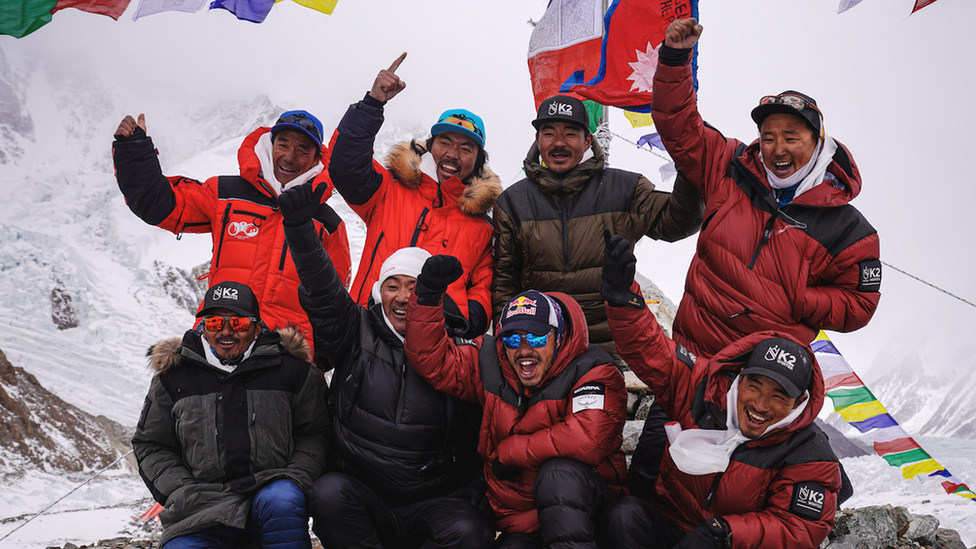
A Nepali team of climbers becomes the first to summit K2 in winter, 16 January 2021IMAGE COPYRIGHTNIMSDAI PURJA
image captionThe Nepali climbers are the first to summit K2 during its dangerous winter season

A team of 10 Nepali climbers has set a new world record by becoming the first to reach the summit of K2, the world's second highest mountain, in winter.

Mountaineer Nimsdai Purja, a member of the group, said they reached the peak at 17:00 local time (12:00 GMT).

Dozens of climbers have been on the 8,611m (28,251ft) mountain this winter hoping to achieve the same feat.

But one Spanish mountaineer has died after suffering a fall this weekend while descending.

K2, which is only 200m shorter than Everest, is part of the Karakoram Range that straddles the Pakistan-China border.

One of only 14 mountains higher than 8,000m, it is widely considered the most demanding of all in winter.

It has long been referred to as "the savage mountain", a name that stuck after US mountaineer George Bell said of his own attempt in 1953: "It is a savage mountain that tries to kill you."

Among the most treacherous sections is the notorious "bottleneck", a couloir liable to icefalls. Eleven climbers were killed there in an avalanche in 2008.

The Nepali climbers were initially spread across three of four competing teams - in all, totalling 60 people. But the 10 Nepalis later formed into a single group to claim the historic achievement in Nepal's name.

Mountaineer Nirmal Purja - a former member of the UK's Special Boat Service - shared an image of the group celebrating their achievement, which was confirmed by expedition organiser Seven Summit Treks.

"We are proud to have been a part of history for humankind and to show that collaboration, teamwork and a positive mental attitude can push limits to what we feel might be possible," said Mr Purja.
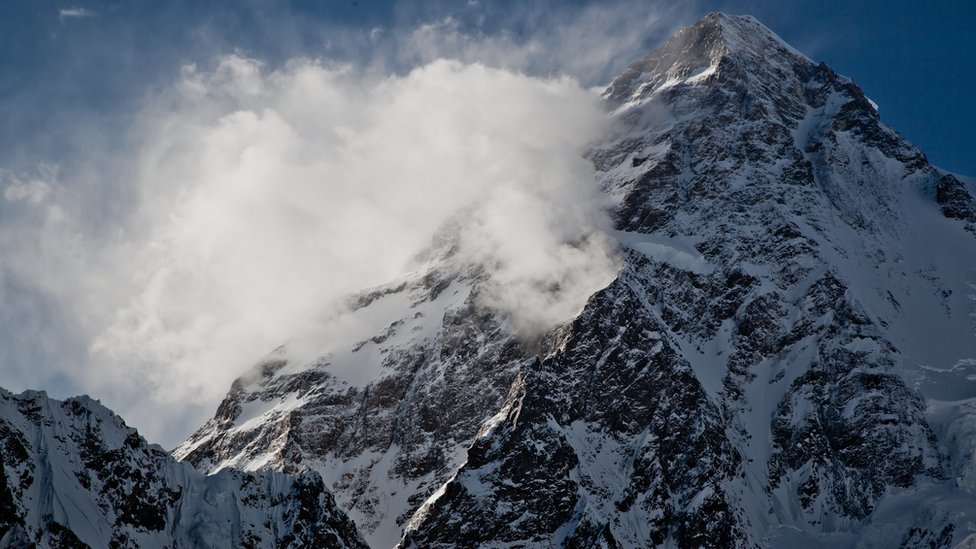
This view shows the upper part of K2 as seen from the broad peak base camp at 4,850mIMAGE COPYRIGHTALEX GAVAN
image captionK2 is one of 14 mountains in the world more than 8,000 metres (26,246ft) in height

Since the first attempt in 1987-1988, just a handful of winter expeditions have been attempted on K2. Until now, none has reached higher than 7,650 metres.

Nepali guides, usually ethnic Sherpas, are considered the backbone of the climbing industry around the Himalayas, and regularly help foreign mountaineers on expeditions.

News of the group's success on Saturday has been praised on social media and sparked joy within the Nepalese climbing community - often left out of the spotlight.

"For decades, Nepalis have assisted foreigners to reach the summits of the Himalayas, but we've not been getting the recognition we deserve," said Kami Rita, speaking to AFP.
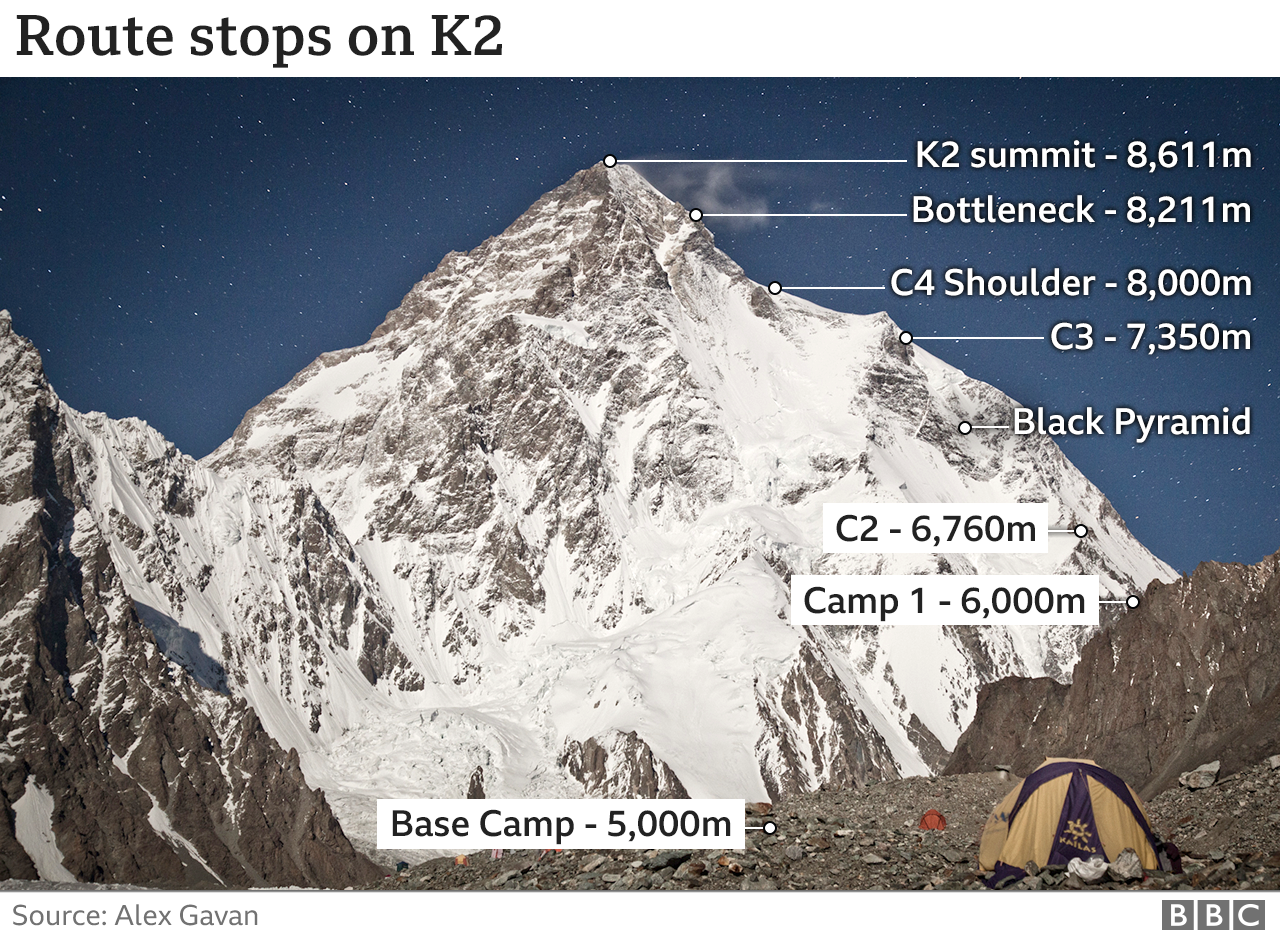
Route stops on K2

"It is wonderful that today on K2 10 Nepalis have made history and shown our bravery and strength," added Mr Rita, who has climbed Everest a record 24 times.

As news of their success broke, it was also confirmed that another climber, Spaniard Sergi Mingote, died after experiencing a severe fall.

Mr Mingote, 49, was based with another team and had been descending to K2's base camp when he slipped and fell.

An experienced mountaineer, Mr Mingote had previously climbed seven of the world's so-called "8000ers", including Everest.

He had been attempting to summit K2 without oxygen but became severely fatigued, forcing him to abandon the expedition.

Coronavirus vaccine: India begins world's biggest drive


Coronavirus vaccine: India begins world's biggest drive


A sanitation worker became the first Indian to receive a Covid vaccine as the country began the world's largest inoculation drive.

Prime Minister Narendra Modi launched the programme, which aims to vaccinate more than 1.3 billion people against Covid.

He paid tribute to front-line workers who will be the first to receive jabs.

India has recorded the second-highest number of Covid-19 infections in the world after the United States.

Millions of doses of two approved vaccines - Covishield and Covaxin - were shipped across the country in the days leading up to the start of the drive.

"We are launching the world's biggest vaccination drive and it shows the world our capability," Mr Modi, said, addressing the country on Saturday morning.


He added that India was well prepared to vaccinate its population with the help of an app, which would help the government track the drive and ensure that nobody was left out.

Mr Modi spoke at length about doctors, nurses and other front-line workers "who showed us the light" in "dark times".

"They stayed away from their families to serve humanity. And hundreds of them never went home. They gave their life to save others. And that is why the first jabs are being given to healthcare workers - this is our way of paying respect to them."


At the scene

Geeta Pandey, BBC News, Delhi

Doctors and medical staff at Delhi's Max hospital tell me a lot of hope is being pinned on the vaccination drive. One official described it "as a new dawn" and said "it's the beginning of Covid's end".

Inside the waiting room, there are posters on the wall with information about the documents one needs to bring, how safe the vaccine is, and the precautions that need to be taken even after one's been vaccinated. Among those being vaccinated on Saturday are doctors, nurses and front-office staff from all departments.

The names have been been chosen alphabetically so those getting jabs are mostly those with names starting with the letter A.

"The pandemic has played havoc in the country. I hope the vaccine will rid us of the fears and we will be able to breathe easy," Dr Anil Dass said after getting the jab.

Ashutosh Chaturvedi, a 31-year-old male nurse described as a "Covid warrior" by hospital officials, became the first recipient of the vaccine at Max.

"I'm fine, I feel good," he told reporters as he came down the hospital ramp, which has been decorated with blue, green and white balloons.

Since April, he told me, he's worked in the emergency wing of the Covid ward, tending to those afflicted with the coronavirus.

"I haven't seen my wife and nine-month-old daughter since then. A month later, once I've received the second dose, I'll visit my family," he said.


Mr Modi also appealed to people to continue adhering to Covid-19 safety protocols like wearing masks and following social distancing. He said the country cannot afford to be complacent as vaccinating the entire population will take time.

He also urged people not to believe any "propaganda and rumours about the safety of the vaccines".

"I want to tell people that the approval to these vaccines was given only after scientists and experts were satisfied about its safety," he said.

An estimated 10 million health workers will be vaccinated in the first round, followed by policemen, soldiers, municipal and other front-line workers.


Next in line will be people aged over 50 and anyone under 50 with serious underlying health conditions. India's electoral rolls, which contain details of some 900 million voters, will be used to identify eligible recipients.

The government plans to vaccinate 300 million people by early August. This will happen in state-run health care centres, schools, colleges, community halls, municipal offices and wedding halls.

Several hospitals across India are giving the first doses of the vaccine.


Dr Atul Peters was among those who got the jab at Max hospital.

"It's a very big day. I'm grateful to those who worked hard to make this a reality. I was very very happy when I got a call informing me that my name was on the list.

"We worked hard during the pandemic to save lives and we are also taking the jab first to dispel fears in people's minds that the vaccine is not safe," he told the BBC.


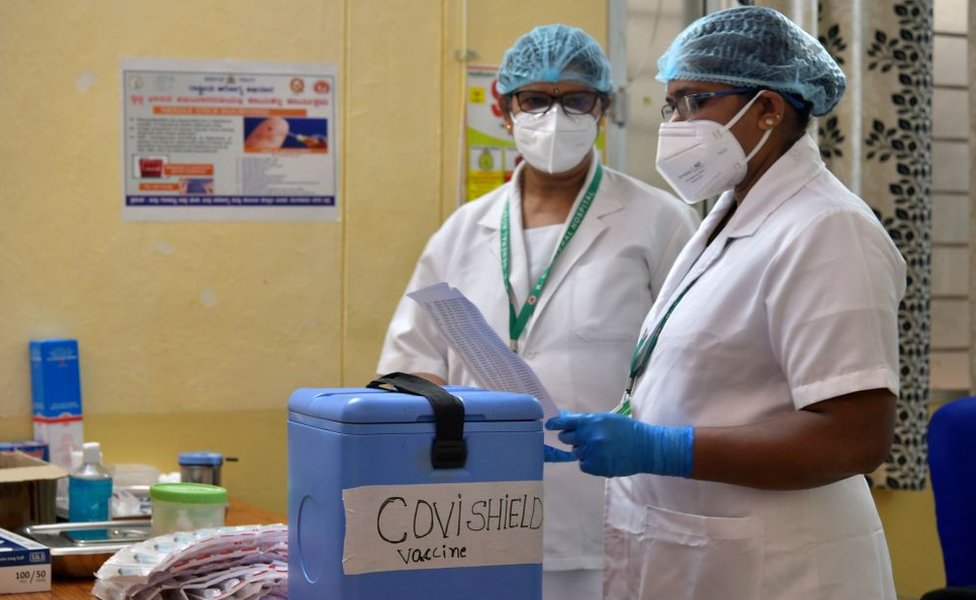
Nurses prepare to administer a Covid-19 coronavirus vaccine to health workers at the KC General hospital in Bangalore on January 16, 2021.IMAGE COPYRIGHTGETTY IMAGES
image captionMillions of vaccine doses have been shipped across India


India's drug regulator has given the green light to two vaccines - Covishield (the local name for the Oxford-AstraZeneca vaccine developed in the UK) and Covaxin, locally-made by pharma company Bharat Biotech.

But concerns have been raised over the efficacy of Covaxin because the regulator's emergency approval came before the completion of Phase 3 clinical trials. The regulator and the manufacturer have said the vaccine is safe, and that the efficacy data would be available by February.

Both vaccines will be given as two injections, 28 days apart, with the second dose being a booster. Immunity would begin to kick in after the first dose but reaches its full effect 14 days after the second dose.

The status of the vaccines and recipients will be electronically tracked in real time - some 8 million people who will receive the early jabs have been already registered. More than 600,000 people have been trained for the drive.

The jabs will be voluntary, and recipients will be given a certificate of vaccination after they complete both doses.

"I expect India's vaccination programme will be run much better than most countries because of the considerable government investment and early preparedness," Dr Gagandeep Kang, one of India's best-known vaccine experts, told the BBC.

With more than 10 million cases, India has recorded the second-highest number of Covid-19 infections in the world, after the US.

The largest vaccination drive in the country, however, begins at a time when infections have fallen sharply, and much of life has returned to normal. A limited availability of doses in the initial phase, therefore, is not likely to pose a problem.

Most scientists feel India is primed for the challenge as it is a vaccine-making powerhouse and has run, for decades, a well-oiled immunisation programme for tens of millions of new-borns and mothers-to-be.

But the real challenges will begin when the general population starts receiving the jabs.

India will use its formidable election machinery to deliver and track doses to recipients in far corners of the country. It is also likely to use digital platforms and apps to enable people to register for the doses.

However, not every Indian owns a smart phone or knows how to operate an app, so it will be interesting to see what the government does to make sure that there are no inadvertent exclusions.

Vaccine hesitancy is the other concern.

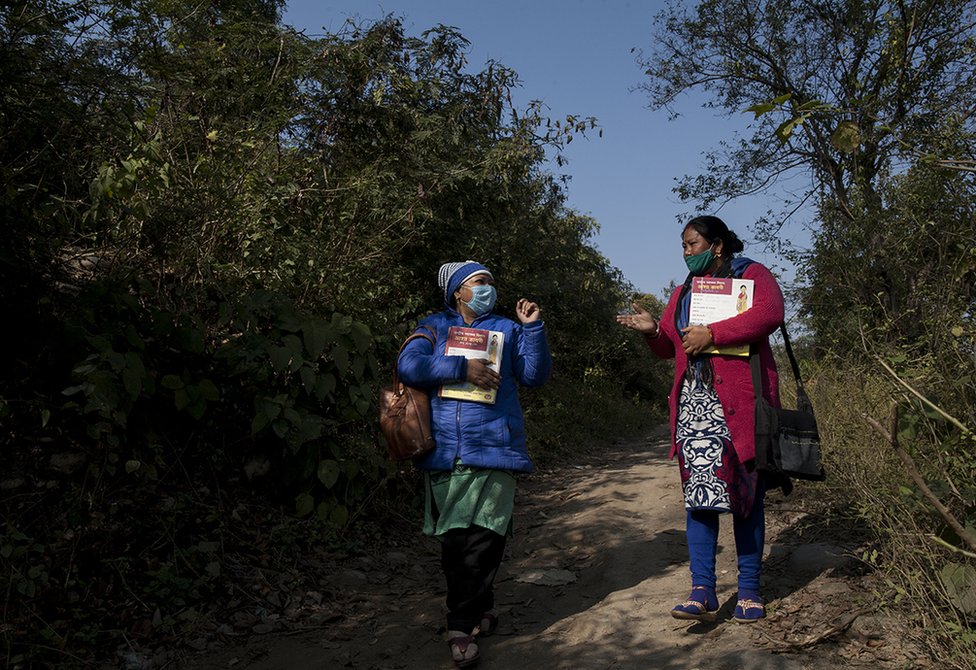
Health activists Seema Pal and Rama NegiIMAGE COPYRIGHTMANSI THAPLIYAL
image captionHealth activists Seema Pal and Rama Negi say they have been busting misinformation about the vaccine

The recent controversy over the hurried approval of Covaxin, many feel, could undermine confidence. There's a history of hesitancy about receiving the polio vaccine in parts of northern India, triggered by rumours about vaccines being impure and affecting fertility. Similar disinformation is now circulating about Covid vaccines on social networking apps, such as WhatsApp.

The government will need consistent, clear-eyed communication to bolster vaccine acceptance and community perception of the programme.

Vaccines come with side effects for some people. India has a 34-year-old surveillance programme for monitoring such "adverse events" following immunisation.

But researchers have found that benchmarks for reporting side effects still remain weak. A failure to transparently report adverse effects could easily lead to fear-mongering around vaccines.

Russia Navalny: Poisoned opposition leader held after flying home

 Russia Navalny: Poisoned opposition leader held after flying home


Kremlin critic Alexei Navalny has been detained after flying back to Moscow five months after he was nearly killed by a nerve agent attack last year.

Mr Navalny, 44, was seen being led away by police at passport control.

His flight from Berlin was diverted from one of Moscow's airports to another after crowds gathered there.

The activist says the authorities were behind the attempt on his life, an allegation backed up by investigative journalists but denied by the Kremlin.

"I know that I'm right. I fear nothing," Mr Navalny told his supporters and the media at Moscow's Sheremetyevo airport just minutes before his detention.

He added that all criminal cases against him had been "fabricated".

Earlier on Sunday, metal barriers were erected inside Moscow's Vnukovo airport, where the plane was originally scheduled to land, and Russian media reported that several activists - including key Navalny ally Lyubov Sobol - were detained there.

Mr Navalny's spokeswoman Kira Yarmysh posted on social media pictures of police cars at the airport.

Mr Navalny - who had been treated in Germany - earlier urged supporters to meet him off the flight, and a "Let's meet Navalny" page was set up on Facebook (in Russian). Thousands of people said they would go or expressed an interest, despite forecasts of extreme cold and the ongoing Covid-19 pandemic.

Mr Navalny collapsed on an internal flight in Siberia last August, and it later emerged he had been poisoned with a Novichok nerve agent.

Russian authorities have consistently denied any role in the poisoning, and the Kremlin has rejected Mr Navalny's claims that President Vladimir Putin himself ordered it.

The Putin critic has said he misses Moscow, is almost fully recovered from the attack, and that there was never any doubt he would return.

Why was he detained?

The Russian authorities earlier warned Mr Navalny could face imprisonment after missing a prison service deadline in December to report at an office in Moscow.

The prison service accuses him of violating conditions imposed after a conviction for embezzlement, for which he received a suspended sentence. He has always condemned the case as politically motivated.

Separately, Russia's investigative committee has launched a new criminal case against him on fraud charges related to transfers of money to various NGOs, including his Anti-Corruption Foundation.

Mr Navalny has asserted that Mr Putin is doing all he can to stop his opponent from coming back by fabricating new cases against him.

News media from around the world gathered at Berlin airport to record the activist's departure from Germany - but Russian federal TV channels and news agencies are ignoring his return.

2px presentational grey line

What kind of reception will Navalny have?


Alexei Navalny has called on supporters to "come and meet me" at Vnukovo airport on Sunday, and a large crowd will likely try to do just that.

The opposition figure may be hoping for protection in numbers, concerned not only for his physical safety but the prospect of being marched off to prison on landing.

But the call for a welcome-home ceremony is also an open challenge to the man Mr Navalny accuses of ordering his murder: Vladimir Putin.

The Kremlin has repeatedly denied that, demanding proof the activist was even poisoned.

In December, Mr Putin argued that Alexei Navalny was a nobody and anyway, he actually laughed, if Russian security forces had wanted him dead, they'd have finished the job.

There were no street protests after Mr Navalny's sudden collapse, and had he remained abroad his influence would have waned, inevitably. But he always vowed to return, despite the risk. The very public way he's doing that suggests a man emboldened, rather than cowed, by his brush with death.


What happened to Navalny?


In August, the opposition leader collapsed on a plane flying home from Tomsk in Siberia to Moscow and the pilot diverted the flight to the city of Omsk, from where he was eventually allowed to fly on to Germany in an induced coma.

He was released from hospital in Berlin in September to continue his recuperation.

Mr Navalny said recently he was able to do push-ups and squat exercises, and therefore had probably almost fully recovered.

Last month, investigative reporters named three FSB agents who had travelled to Tomsk at the time Mr Navalny was there, and said the specialist unit had tailed him for years.


Mr Navalny then, in a phone call, duped an FSB agent named Konstantin Kudryavtsev into revealing details of the operation against him, according to the Bellingcat investigative group.

The agent told him that the Novichok used to poison him was placed in his underpants.

Mr Kudryavtsev said during the phone call he had been sent to Omsk later to seize Mr Navalny's clothes and remove all traces of Novichok from them.

President Putin has dismissed the investigation by Bellingcat and others into who poisoned Mr Navalny as "a trick" and said that he was backed by US intelligence services.