Showing posts with label South & Central Asia. Show all posts

Sunday, July 22, 2018

The Observer view on Imran Khan and the Pakistan elections


Any new government lacking honest democratic credentials will be ill-equipped to confront the country’s challenges


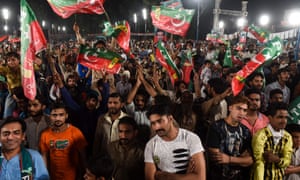
Supporters of Imran Khan at a rally in Multan. Photograph: Ss Mirza/AFP/Getty Images


It seems all but impossible to discuss this week’s national elections in Pakistan without resorting to cricketing metaphors. That’s because the candidate who is widely tipped to win, Imran Khan, is famous less for his political acumen than for his captaincy of the Pakistan team that won the Cricket World Cup in 1992. In British terms, this is the equivalent of the late, much-missed Bobby Moore running for prime minister.

Thus, in well-spun media reports from the campaign trail, Khan’s party, Pakistan Tehreek-e-Insaf (PTI), is said to be poised to hit the opposition for six. Khan’s rival, the jailed former prime minister Nawaz Sharif, is stumped for an answer. And Sharif’s party, the Pakistan Muslim League-Nawaz (PML-N), is appealing to the umpire against alleged ball-tampering by the “establishment”, meaning the army.


Imran Khan near victory in Pakistan election but some ask if he is playing fair

All well and good, but it does not take a spoilsport to point out the future of Pakistan’s democracy is not a game. The stakes are high in a youthful country of 200m, where many still live in grinding poverty. Although the economy expanded by nearly 6% in the year to June, the current account deficit is rising fast, partly due to currency devaluations. Economists say another IMF bailout may be unavoidable.

Pakistan’s next government also faces stiff challenges from hardline Islamist parties, which execrate the country’s “blasphemous”, western-educated, landed, secular elites and from violent extremists. Running for office in Pakistan can be a hazardous affair, as Benazir Bhutto’s assassination in 2007 demonstrated. The current campaign has been marred by a suicide bombing in Balochistan that killed 149 people.

Then there are wider, strategic concerns relating to war-torn Afghanistan, where Pakistan’s intelligence services have a history of meddling, and to India, a bigger, nuclear-armed and more successful competitor. Angered by what he claimed was Islamabad’s covert support for terrorism, Donald Trump vowed to slash US aid earlier this year. But that may only have enhanced China’s influence as a lender, development partner and supposed PML-N backer.


Pakistan elections: who is standing and what is at stake?

Khan’s cynical wooing of the religious parties (which earned him the nickname “Taliban Khan”), his anti-American rants and his election stance as an anti-corruption, populist champion of change, notwithstanding his privileged Oxbridge upbringing, have left some voters unsure whether he can be trusted. His tweeted suggestion that Sharif was somehow behind the Balochistan bomb was unseemly.


But the PML-N, now led by Nawaz’s brother and fellow Punjabi feudal baron, Shehbaz Sharif, is scarcely a more confidence-inspiring choice. What is vital is that the army, which is said to favour Khan, does not succeed in its alleged efforts to rig the vote and dictate Wednesday’s outcome. Any new government lacking honest democratic credentials will be ill-equipped to confront the country’s challenges.

Imran Khan near victory in Pakistan election but some ask if he is playing fair

Imran Khan near victory in Pakistan election but some ask if he is playing fair

Former cricket star galvanises support for PTI party with pledge to end corruption
 
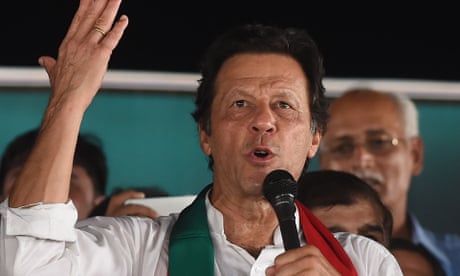
Imran Khan gives a speech during a political campaign rally outside Lahore. Photograph: Arif Ali/AFP/Getty Images


On a stage high above a hockey stadium to the north of Lahore, a compere shrieks into the microphone. Supporters of Imran Khan clamber onto rows of chairs. Then the 65-year-old cricket legend steps forward.

With a general election due to be held on Wednesday, the leader of the Pakistan Tehreek-e-Insaf (PTI) is just a bat swing away from a victory he has pursued relentlessly since relinquishing a glamorous London lifestyle of celebrity and nightclubs more than 20 years ago.


“This is an opportunity to change Pakistan,” he tells an 8,000-strong crowd in the poor suburb of Shahdara, as moths collide with high-powered floodlights. “You will not have it again and again.”


Merchants inside the stadium cash in on Khan’s celebrity with T-shirts, phone covers and flags decorated with the craggily handsome features of the “Captain” who led Pakistan to victory at the 1992 cricket World Cup. But it is his promise to end corruption that has transformed the party he founded in 1996, and which held only one seat in parliament until 2013, into the probable leaders of the next government.


Claiming that $10bn (£7.6bn) is laundered out of Pakistan each year, the populist, socially conservative leader hits out at the “traitors who have made this country poor”.


Khan’s political fortunes have risen steadily in the year since he successfully petitioned Pakistan’s supreme court to disqualify the former prime minister, Nawaz Sharif, on corruption charges. Earlier this month, Sharif was imprisoned on a 10-year sentence: from the stage, a PTI official claims that that a jailer switches on Sharif’s television during Khan’s rallies, forcing him to watch his tormentor-in-chief.


“Have you seen Avenfield House?” Mohammed Asif asks outside the rally. “Those are my flats,” says the 33-year-old Khan supporter, referring to four properties in Park Lane, London, which lie at the heart of Sharif’s corruption case. “They belong to the people of Pakistan.”

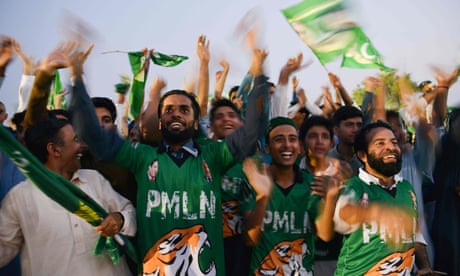
 Khan supporters at the rally. Photograph: Arif Ali/AFP/Getty Images


But Khan is a deeply polarising figure and his poison-tongued campaign inflamed political tensions. After he called supporters of Sharif’s Pakistan Muslim League-Nawaz (PML-N) “donkeys”, an animal charity reported that PTI aficionados had beaten one of the animals close to death.

Khan implied in a tweet following the deaths of 149 people an Isis-claimed suicide attack on 13 July in the eastern province of Balochistan that the PML-N was behind the attack as a way to distract attention from Sharif’s legal woes. “Beginning to wonder why whenever Nawaz Sharif is in trouble, there is increasing tension along Pakistan’s borders and a rise in terrorist acts? Is it a mere coincidence?” he asked.

More damaging to his claims to represent a break with the status quo is the accusation that Khan is taking advantage of the support of Pakistan’s powerful military establishment, which has ruled the country for nearly half of its coup-studded 71-year history. Polls show the two parties neck-a-neck but PML-N leaders appear so downcast as to have practically conceded.

“Sharif is just crying about the election as this is the first time he hasn’t been able to use his own umpire,” Khan said at the Shahdara rally.


In political terms, Khan has plenty of incentive to seek out shortcuts, according to analysts . The PML-N has had a broadly positive record in government over the last five years, in which the party has notably reduced power blackouts. According to political commentator Fasi Zaka, this means “it would not have been his election” without a military-backed campaign against the party in which supportive media channels have been taken off air, politicians have been pressured to defect, and the courts selectively targeted its leaders.

In a recent interview with Dawn newspaper, Khan lamented that “this is not Europe, you cannot just tell people what you stand for and they will vote for you”. This is a lesson he appears to have learned from the election of 2013, when he worked himself into the ground – eventually falling off stage and being hospitalised.

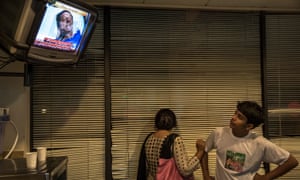
 People watch a 2013 television interview with Imran Khan in intensive care after he sustained an injury falling. Photograph: Daniel Berehulak/Getty Images


Since then, his campaign has evolved from promises of a “New Pakistan” – better schools, better hospitals, an end to pilfering from the state – into something more traditional. Around one third of his party’s candidates are recently recruited “electables”, long-in-the-tooth politicians who bring with them vote banks and, often, corruption scandals. These characters, many believe, will help the PTI crack the crucial province of Punjab, which returns more than half the 272 directly elected seats in the National Assembly.


But former allies told that many believe that the party has shifted away from its anti-corruption platform. “There are cuckoos in the PTI nest,” Brigadier Samson Sharif, the party’s ex-shadow defence secretary, said. Khan “now has so many albatrosses hanging around his neck … he is a pied piper leading the people nowhere”.


Born in Lahore in 1952, the Oxford-educated cricketer has also undergone what appears to be significant a personal transformation. While he used to party with Mick Jagger, today he defends Pakistan’s strict blasphemy laws and criticises “Westoxified” Pakistani liberals.

In 2017, the provincial government his party has run for the past five years in the northern province of Khyber Pakhtunkhwa granted $3m to the Haqqania madrassa, a fount of Taliban fighters, drawing sighs of “Taliban Khan” from the coffee shops frequented by Islamabad’s liberals. Others note the arc of his marriages: first came Jemima Khan, a glamorous British heiress. Earlier this year Khan secretly wed his spiritual adviser, Bushra Maneka.

Still, the spectre of an electorally poisonous playboy past was revived with the publication this month of a kiss-and-tell memoir by his second wife, Reham Khan, a former news anchor, PDF copies of which were shared far and wide on Pakistani WhatsApp. She alleges he used “six grams” of cocaine a night, has several love-children and sexts women in his party. “She is just a porn star,” says supporter Zulfikar Ali Khan, repeating the argument of PTI insiders that the book’s publication was co-ordinated with the PML-N.

If the book was a ploy, it seems unlikely to pay off. According to Credit Suisse, the PTI stands a 75% chance of forming a coalition government under Khan. Some supporters even celebrate the army’s alleged tilting of the field as proof that the institution is doing its job. “If they are involved, they are in favour of Pakistan,” says Umair Iqbal, 25. “Even if you put down a vote for PML-N,” adds Shehzar, 19, “it will go to PTI. The PML-N has no chance of forming a government as it has no supporting hands.” In reference to the army, he said: “They know how to bowl you out.”


That appears a blessing to Khan for now. But with a looming economic crisis, political instability and an assertive military establishment to handle, Pakistan’s probable next “Captain” will have to zealously guard his own stumps.