Showing posts with label NEWS. Show all posts

Sunday, January 17, 2021

Phil Spector: Pop producer jailed for murder dies at 81

 Phil Spector: Pop producer jailed for murder dies at 81

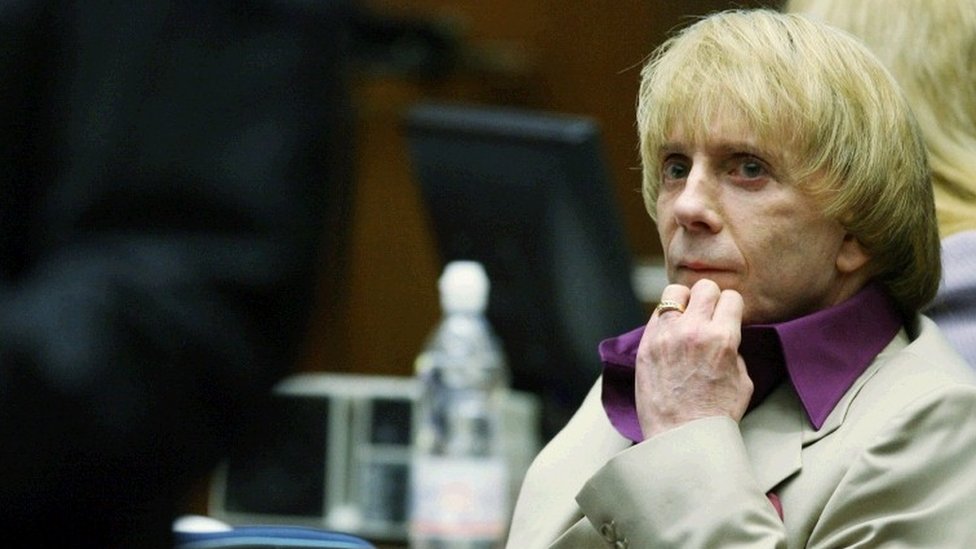
Phil Spector in court during his murder trialIMAGE COPYRIGHTGETTY IMAGES
image captionPhil Spector pictured in court during his murder trial

US music producer Phil Spector has died at the age of 81, while serving a prison sentence for murder.

Spector, who transformed pop with his "wall of sound" recordings, worked with the Beatles, the Righteous Brothers and Ike and Tina Turner.

In 2009, he was convicted of the 2003 murder of Hollywood actress Lana Clarkson.

His death was confirmed by the California Department of Corrections and Rehabilitation.

"California Health Care Facility inmate Phillip Spector was pronounced deceased of natural causes at 6:35 p.m. on Saturday, January 16, 2021, at an outside hospital. His official cause of death will be determined by the medical examiner in the San Joaquin County Sheriff's Office," it said.

Spector produced 20 top 40 hits between 1961 and 1965, AFP news agency reports. His production methods influenced major artists including the Beach Boys and Bruce Springsteen.

His life was ultimately blighted by drug and alcohol addiction, and he all but retired from the music scene during the 1980s and 1990s.

In February 2003, actress Lana Clarkson was found dead at his house in Alhambra, California with a bullet wound to her head. Clarkson, who was known for her work in the sword-and-sorcery genre and starred in films including Barbarian Queen, had met Spector hours earlier at a nightclub.

Spector claimed the shooting happened when Clarkson "kissed the gun" - but his trial heard from four women who claimed Spector had threatened them with guns in the past when they had spurned his advances.

Following an initial mistrial, Spector was convicted of second degree murder and given a sentence of 19 years to life.

Lana ClarksonIMAGE COPYRIGHTALBERT L. ORTEGA/WIREIMAGE
image captionLana Clarkson was an actress and model who starred in the film 1985 Barbarian Queen
1px transparent line

Harvey Phillip Spector was born in New York in 1939, to Russian-Jewish parents. His father killed himself when Spector was a boy, and his mother moved her family to Los Angeles.

He began his career in his teens as a performer, forming a band - the Teddy Bears - with three high school friends. They had a hit single in 1958 with a song that took its title from the wording on his father's gravestone: "To know him is to love him."

The record went to number one on the Billboard Hot 100, but the group split the following year.

Spector founded his own record label, Philles, in 1961. He produced high-profile 1960s girl groups such as Crystals and the Ronettes, including on 1963 hits "Be My Baby" and "Baby I Love You".

He also worked on The Righteous Brothers' hits "You've Lost That Lovin' Feelin'" and "Unchained Melody."

Phil Spector with the RonettesIMAGE COPYRIGHTGETTY IMAGES
image captionSpector produced hits for The Ronettes, later marrying their lead singer Ronnie Bennett

His signature production technique, the "Wall of Sound," involved layering several instruments, including strings, woodwind and brass, to give a lush, orchestral sound.

In the early 1970s, Spector collaborated with The Beatles on their final album "Let It Be," as well as producing John Lennon's solo album "Imagine".

As the decade progressed, the much-feted producer became reclusive and disturbing accounts of his behaviour became widespread. Spector is said to have held a gun to singer Leonard Cohen's head during sessions for his album "Death of a Ladies' Man."

Ronettes lead singer Veronica "Ronnie" Bennett, who became Spector's second wife and divorced him in 1974, wrote in her 1990 autobiography that he subjected her to years of horrific abuse. She said he had threatened to kill her and display her body in a glass-topped coffin he kept in her basement.

"I can only say that when I left in the early '70s, I knew that if I didn't leave at that time, I was going to die there," Ronnie wrote of the time.

Weeks before Lana Clarkson was shot dead, Spector gave a rare interview to British broadsheet The Telegraph.

"I would say I'm probably relatively insane, to an extent," he told the paper, adding that he had "devils inside that fight me".

Responding to news of the producer's death, Blondie guitarist Chris Stein tweeted: "When we went to Phil Spector's house in the 70s he came to the door holding a bottle of diet Manischewitz wine in one hand and a presumably loaded 45 automatic in the other. Long story.

"I thought he was nuts."

Saturday, July 28, 2018

Are LED lights making us ill?

Over the last decade, much of Europe and the US have changed the way they illuminate city and town streets.

Councils and local governments from Paris to Brooklyn have replaced high-energy sodium bulbs (the warmer, yellow ones) with energy-saving LED bulbs (with a blue light emitting diode, which can feel harsh in comparison). As well as street lights, most of us are exposed to blue light through smartphones, computers, TVs, and in the home.There are growing concerns that LED lights may have a negative impact on human health. © Dong Wenjie/Getty

Earlier this year, the World Journal of Biological Psychiatry published a paper by a group of prominent psychiatrists that warned of the potential effects of LED lighting on mental illness.

It raised concerns about the influence of blue light on sleep, other circadian-mediated symptoms, use of digital healthcare apps and devices, and the higher sensitivity of teenagers to blue light.

“My concern about LED lighting followed from a larger, earlier concern about the relationship between light exposure and the occurrence of manic and mixed symptoms in bipolar disorder,” said John Gottlieb, Clinical Assistant Professor of Psychiatry and Behavioral Sciences at Feinberg School of Medicine in Chicago and an author of the paper.

“I had already clearly seen that supplemental light exposure - in the form of bright light therapy - was extremely helpful to patients with depression. What I was slower to realize was that excess and poorly-timed light exposure could have adverse effects on manic states and the sleep-wake cycle,” he said.

The paper has implications for the treatment of mental illness. If a person is prescribed a self-monitoring app, and instructed to use their smartphone to document mood changes, for example, and they do this before bed, it could have an adverse effect on their sleep, circadian rhythms and health.

“Because they are ubiquitous, smartphones represent the larger public health hazard,” said Gottlieb. “Streetlights, though, are not benign and together with the entire set of nocturnal lighting for entertainment, traffic, reading, etc contribute to the phenomena of light pollution, which we are becoming increasingly sensitised to.”Streetlights contribute to the phenomena of light pollution. © Andr Dogbey/EyeEm/Getty

Studies of the impact of blue light on healthy adults show it inhibits melatonin secretion which disrupts sleep and can affect quality of life, physical and mental health and susceptibility to illness. Previous studies of sleep disorders in children and adolescents show a clear and consistent relationship between sleep disorders and frequency of digital device usage.

Currently, the National Sleep Foundation guidelines suggest not using technology 30 minutes before bed and removing technology for the bedroom. However, there are currently no specific guidelines for people with an underlying mental illness or sensitivity to circadian disruption.

As LED technology has rapidly spread across the globe, the focus has been on the visual element and the energy-saving element. Now, scientists, health professionals and the LED industry are working to minimise the blue light in LEDs and create customisable lights that won’t harm those suffering from psychiatric disorders.

The ocean is a strange place after dark

Moonlight triggers the world’s biggest orgy, strange creatures emerge from the depths, and waves glow blue. Some phenomena in the ocean can only be witnessed after dark.

1. Bioluminescence makes the sea shimmer


Dinoflagellates emit blue light when they’re disturbed, like at this bay on Vaadhoo Island in the Maldives (Credit: Naturepl.com/Doug Perrine)


You may have seen the pictures.

It’s night-time in an impossibly exotic location. Waves are breaking on the beach. The water is sparkling with electric blue lights.

The internet loves an image of a magical-looking bioluminescent bay. You may also have seen travel bloggers bemoaning the real event as not quite living up the hype.

Even if the latter is true, bioluminescence (in this case usually caused by planktonic organisms called dinoflagellates) is a pretty amazing natural phenomenon.

Dinoflagellates emit blue light when disturbed, which is why they can be seen sparkling over wave crests, around boats or when a hand or paddle runs through them.

These tiny creatures are the most common source of bioluminescence at the ocean’s surface.

So-called bioluminescent bays such as in Puerto Rico and Jamaica are among the best-known places to witness the glow. However, the ephemeral phenomenon can be found throughout the ocean where there are dense gatherings of dinoflagellates.

Sometimes dinoflagellates’ population increases rapidly causing blooms, which by day are coloured a less attractive red-brown, sometimes known as red tides. And some, but not all, of these red tides are poisonous.


These tiny creatures provide the most common source of bioluminescence at the ocean’s surface (Credit: Naturepl.com/Martin Dohrn)


Even stranger and rarer than bioluminescent bays are “milky seas”, where continually glowing water stretches for as far as the eye can see.

Milky seas have only been seen a few hundred times since 1915, mainly concentrated around north-western Indian Ocean and near Java, Indonesia.

They are not caused by dinoflagellates, but are thought to be the result of “bioluminescent bacteria that have accumulated in large numbers near the surface”, explains to Dr Matt Davis, Assistant Professor of Biology, St. Cloud State University in the US, who specialises in bioluminescence.

Reports by sailors over the centuries have described milky seas as a nocturnal whitish glow like a field of snow, but scientists have had little chance to investigate the phenomenon first-hand.

In 2005, researchers analysing archived satellite images found that milky seas could be seen from space and that one satellite had captured images of a huge area of ocean that had displayed the strange glow for three consecutive nights a decade earlier.

2. Animals glow in the dark


Bobtail squid have a symbiotic relationship with bioluminescent bacteria (Credit: Naturepl.com/Jurgen Freund)


Bioluminescence, the emission of visible light by an organism as the result of a natural chemical reaction, is common among marine life such as fishes, squid and molluscs. In the deep sea most species are bioluminescent, where it is the main source of light.

In shallower waters, most bioluminescent fish display their lights at night.

“Flashlight fishes have a specialized pouch under their eye that they can rotate to expose the light emitted from these bacteria, and they use this glow at night to hunt for food and communicate,” says Dr Matt Davis.


Flashlight fishes have a specialised pouch under their eye that use to expose bioluminescent bacteria (Credit: Matt Davis)


Ponyfish emit light from the bioluminescent bacteria housed in a pouch using transparent muscular shutters, to communicate, he explains.

Camouflage, defence and predation are among the variety of reasons fishes are thought to emit light.

For example, bobtail squid have an ingenious way of using lights. These nocturnal animals have a mutually beneficial relationship with luminescing bacteria that live in a mantel cavity on its underside. At night the squid control the intensity of this light to match the moonlight, and can reduce their silhouette to camouflage themselves from predators.

3. Moonlight triggers the planet’s biggest orgy


Mass spawning on the Great Barrier Reef is one of the extraordinary examples of synchronised behaviour on Earth (Credit: Naturepl.com/Jurgen Freund)


There is nothing more romantic than a moonlit night, especially if you are a coral on the Great Barrier Reef off Australia.

One night a year in spring, the biggest orgy on earth is triggered by lunar light.

Over 130 coral species simultaneously release their eggs and sperm into the water during a window of just 30-60 minutes.

This mass spawning event might be the most extraordinary example of synchronised behaviour in the natural world.

When the gametes – eggs and sperm cells - are released they hover for a moment, forming a ghostly replica of the reef’s shape, before dispersing into an underwater blizzard as the sperm fertilise the eggs.

Dr Oren Levy, a marine biologist and ecologist and Professor of Life Sciences at Bar-Ilan University, Israel, has studied this extraordinary event.

“This is really fascinating phenomena…we know this event is going to happen a few nights after November's full moon each year, three to five [days] post full moon,” he says.

“[It is] always amazing, in particular I am so amazed how each of the coral species year after year spawn at the same hour of the night.”

He adds: ”Once it happens it is always so exciting to see how everything is becoming so live and synchronised. It is almost [a] spiritual event and you understand the power of nature in its best.”

Moonlight triggers the phenomenon by acting as a synchroniser or “alarm” probably with other environmental signals such as sunset timings, water temperature and tides to cue the time of the gamete [egg and sperm cells] release, explains Dr Levy.

He adds that corals seem to possess photoreceptors that detect the phases of the moon, which helps with the “fine tuning” of the gamete release.

4. Sharks and seals rely on celestial light


Just when you think it's safe to go into the water... great white sharks hunt at night too (Credit: Naturepl.com/Chris & Monique Fallows)


For some seals, moonlit nights spell danger.

During winter months, the 60,000 cape fur seals on Sea Island in False Bay, South Africa run the gauntlet of being picked off by great white sharks patrolling the seas when they enter and exit the water.

One study in 2016
hypothesised seals swimming at night during a full moon are at more risk of being eaten by a shark since bright moonlight silhouetting them against the surface makes them an easy meal for predators lurking below.

However, most shark attacks on seals happen just after sunrise. Researchers behind the study, which measured shark attacks at dawn, were surprised to find seals were much less likely to be predated at this time of day if there was a full moon.

The researchers theorised that lunar illumination combined with emerging sunlight may decrease the stealth ability of the sharks and that the advantage switched from sharks to seals as night turned to day.

And seals may rely on another celestial feature to navigate - the stars.

Captive harbour seals (Phoca vitulina) are able to locate a single lodestar and steer by it
, researchers have shown.

During a test using a simulated night sky, seals swam towards the brightest star and could orientate themselves when the stars were swivelled around.

In the wild, seals need to navigate the open ocean to find foraging grounds that may be separated by hundreds of kilometres.

Researcher Dr Bjorn Mauck said at the time: "Seals might learn the position of the stars relative to foraging grounds during dawn and dusk when they can see both the stars and landmarks at the coast."

5. Strange animals come to the surface every night


Humboldt squid are among the most striking creatures to surface every night (Credit: Naturepl.com/Franco Banfi)


Under the cover of darkness rarely seen creatures migrate to the ocean’s surface to feed.

The Humboldt squid, also known as the jumbo squid, is one of the most eye-catching marine animals you can see lurking in surface waters.
By day the squid lurk in the deep waters of the Eastern Pacific Ocean along the deep shelf that runs off the west coast of the Americas and every night they are one of the many ocean animals to migrate upwards to find dinner.

Vertical (or diel) migration - when ocean animals swim to the surface at dusk and disappear down again at dawn – is extremely common.

“What [Humbioldt squid are] doing largely is following their main food item, which is the so-called lantern fish,” explains Professor Paul Rodhouse, an Emeritus Fellow for the British Antarctic Survey (BAS) and former head of the organisation’s biological sciences division.

In turn, lantern fish follow vertically migrating zooplankton.

Since zooplankton are depended on by so many ocean animals, “the rest of the food chain will be following on after it,” says Prof Rodhouse.

“It is a huge movement of biomass every day,” says Prof Rodhouse. “More than a thousand metres. Some of the oceanic squid probably migrate over 1000m every day.”

He adds that almost all pelagic species (animals that live in the water column not near the bottom or shore) that can swim make the journey.

Humboldt squid are among the most striking creatures to surface every night. Their ability to change colour and flash bright red when agitated has earned them the nickname “red devils”. Although much smaller than their cousin, the 13m-giant squid, they can reach a length of about 1.5m (almost 5ft). Highly aggressive predators, they capture prey with strong tentacles and suckers and tear into it with powerful beaks, and have reportedly occasionally attacked humans.

But even ferocious Humboldts are preyed upon by bigger predators such as billfish, swordfish and sharks.

“Of course what they are all doing [by being active at night] is avoiding predation by the top predators,” says Prof Rodhouse. "The big predators that are visual predators and which stay in the surface waters and see their prey.”

“So they’re all… reducing the risk of being preyed on by going down into deep, dark waters at night.”

The mystery of Scotland's 'disappearing' eagles

Image result for eagles

Who is attacking Scotland’s raptors? And what, eactly, happened to Fred?


It was late January when Fred disappeared. A young golden eagle, he would have had characteristic brown-gold feathers and of course that hooked bird-of-prey beak, bright lemon-coloured and black. Fred had been monitored near the Pentland Hills – not far from Edinburgh in Scotland.

The previous summer, Ruth Tingay, from conservation group Raptor Persecution UK, had watched as a colleague fitted a tag to the raptor at its nest site. She had been tracking Fred’s movements ever since.

The trip to the Pentlands was the furthest he’d been.

“He’d only been gone from the nest site for three or four days,” she says. It was on 20 January 2018 when the signal went blank.

Then, unexpectedly, it returned four days later. But in a very strange place: about 10 miles out at sea near St Andrews. Quite far north-east from where Fred’s signal had last been seen, did it reveal that Fred had been killed and dumped at sea?Raptors like golden eagles appear to be shot more often than they used to be (Credit: Javier Fernández Sánchez/Getty)

Conservationists despaired. Another disappearing golden eagle that seemed to have met a suspicious end. Raptors are sometimes killed by humans, but the perpetrators are notoriously difficult to catch. Police Scotland are now investigating Fred’s case.

Scotland is home to various raptor species, but golden eagles (Aquila chrysaetos) are perhaps the most iconic. While their population in Scotland is generally doing well, they struggle to survive in some areas, particularly in the south of the country. One project is hoping to change that by translocating birds there from the highlands.

Other raptors are having an even tougher time – notably hen harriers, numbers of which are clearly declining. These birds, too, are sometimes killed illegally.

But who is attacking Scotland’s raptors? And what, exactly, happened to Fred?

More signs of suspicious activity in Fred’s case were revealed after Raptor Persecution UK got in touch with the manufacturer of his tag. It had been set up to record GPS coordinates for the bird and also connect to nearby mobile phone masts. Ordinarily that mobile network data wouldn’t have been available to the conservationists, but the tag maker was able to provide access.Sat-tagged hen harrier, Annie, found shot on a grouse moore, April 2015 (Credit: RSPB)

The results were startling – during that period of absence late in January, it looked as though Fred had travelled east seemingly along a road, south of Edinburgh, and then north over the Firth of Forth and out towards St Andrew’s.

“It showed a pretty clear direction of travel up to the North Sea,” says Tingay. The tag hasn’t transmitted any data since those last data points were collected. And it isn’t known whether it was still attached to Fred at the time of these mysterious movements, or whether it ultimately sank to the bottom of the sea. The trail, in other words, has gone cold.

“There are so few breeding golden eagles in south Scotland so he was an important bird,” says Tingay. “To lose him so soon after he left his natal [area]… is pretty shocking really.”

The strange movements of Fred are “absolutely undoubtedly” a result of human interference, says Ian Thomson at the Royal Society for the Protection of Birds (RSPB).

“We’ll probably never know exactly how it happened,” he adds. Thomson has been monitoring raptor killings in Scotland for years. He says there is a large weight of evidence linking the deaths to areas where grouse moors exist. There have been cases in which gamekeepers have killed raptors as a means of preventing them preying on grouse – which they need to retain in large numbers for the game shooting season.

Prosecutions are rare, though, and blame levelled at gamekeepers often proves controversial. According to a spokesman for the Scottish Gamekeepers Association, the body has suspended six members over five years for wildlife crime offences.

“As an organisation, we advocate only legal means to resolve species conflicts,” he adds. Part of the problem for anyone monitoring raptor deaths is that whoever is killing birds of prey seems to have become more determined to cover their tracks in recent years, explains Thomson.Who is attacking Scotland’s raptors? (Credit: RSPB)

For example, he says the RSPB has evidence to suggest that raptors like golden eagles appear to be shot more often than they used to be – perhaps so the perpetrators can easily remove the carcass so less evidence is available to investigators.

“In the last six or seven years there does appear to have been a significant move away from the illegal use of poisons,” adds Thomson.

Logan Steele, of the Scottish Raptors Study Group, agrees. “We’re finding a lot of birds with satellite tags disappearing, no bodies found,” he says.

The group has tagged in excess of 150 birds in recent years, he adds. He’s currently monitoring data from a hen harrier that has just started to move about the country more widely. “I’m hoping it will survive,” he says.

While there are those who would harm Scotland’s magnificent birds of prey, there are plenty of others working to protect these creatures wherever they can. Sadly, their work is still cut out for them, says Tingay: “It’s hard to know whether it’s improving or not but I certainly haven’t seen any evidence of a decline in persecution.”

Lunar eclipse: Century's longest 'blood moon' delights skygazers

Skywatchers around the world have witnessed the longest "blood moon" eclipse of the 21st Century.

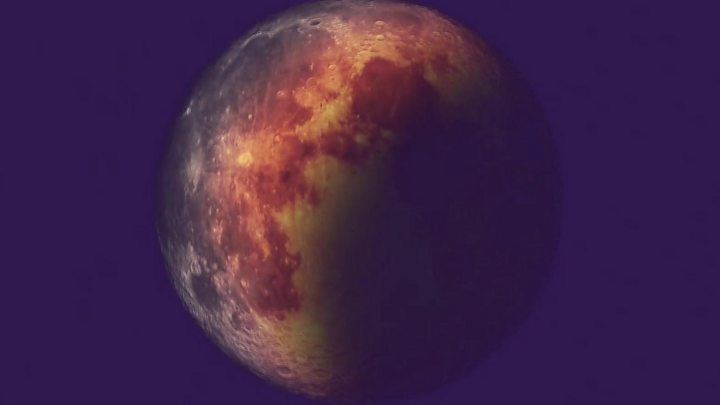
As it rose, during this total eclipse, Earth's natural satellite turned a striking shade of red or ruddy brown.

The "totality" period, where light from the Moon was totally obscured, lasted for one hour, 43 minutes.

At least part of the eclipse was visible from Europe, the Middle East, Africa, Australia, most of Asia and South America.

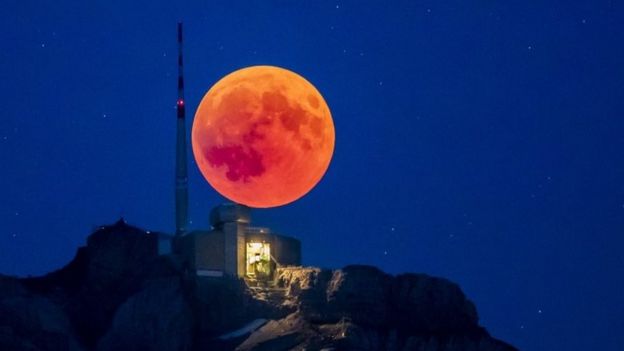
In pictures: Blood moon seen around the worldImage copyrightEPAImage captionThe blood moon as seen in the Swiss Alps...Image copyrightGETTY IMAGESImage caption... and in Kuala Lumpur
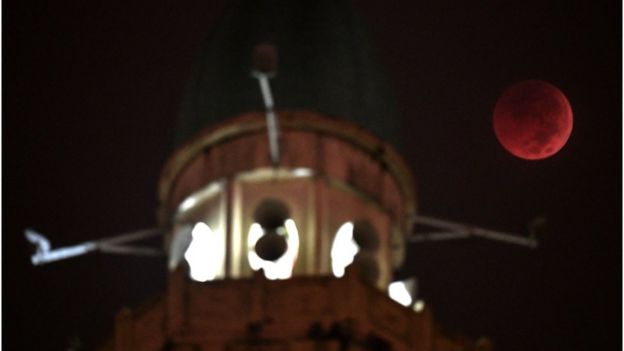
In the UK, where the weather allowed, the Moon could be seen to turn red - fully eclipsed by Earth - from when it rose at 21:00 until 22:15 BST.

Over the coming days, Mars will be at its closest point to Earth since 2003 - visible as a "bright red star" where skies are clear.

The Moon passed right through the centre of the Earth's shadow, at the shadow's widest point.


Science behind the blood moonExit player
Media captionScience behind the blood moon

"This is actually almost as long as a lunar eclipse could be," Prof Tim O'Brien, an astrophysicist at University of Manchester, explained.

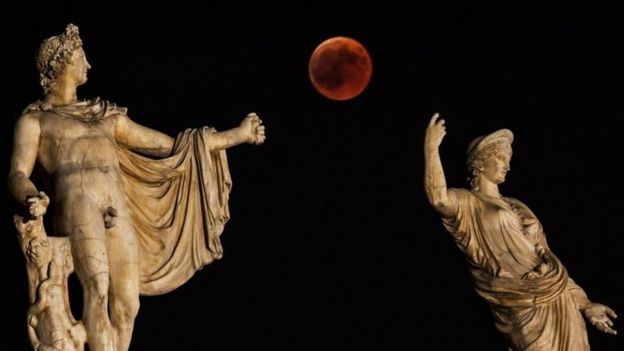
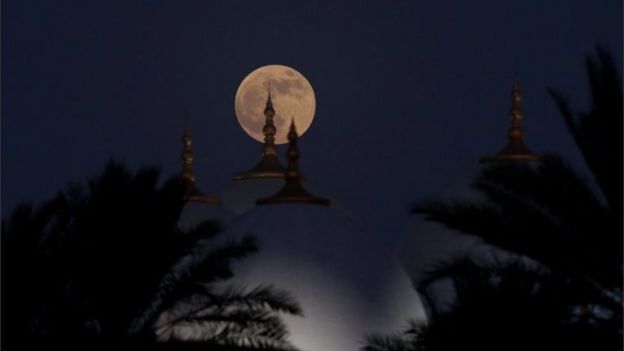
It coincided not only with Mars's close approach, but with what he described as a "procession of planets" - a line-up of our celestial neighbours that gave skywatchers a particularly good view of Venus, Jupiter, Saturn and Mars.Image copyrightAFPImage captionThe blood moon beside a statue of ancient Greek goddess Hera and god Apollo in AthensImage copyrightREUTERSImage captionThe blood moon rises behind the Sheikh Zayed Grand Mosque in Abu Dhabi
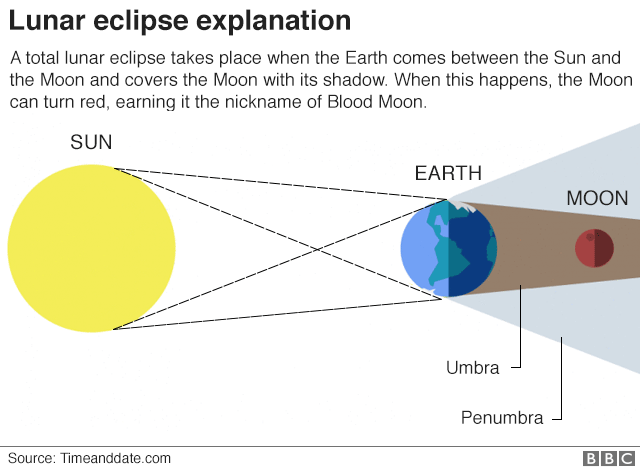
Eclipse terms

Umbra: The darker, central part of the Earth's shadow

Penumbra: The lighter, outer part of the shadow cast by our planet

Because the Moon is far away from Earth relatively speaking - its orbit is an ellipse, so it moves closer and further and looks larger and smaller from Earth.

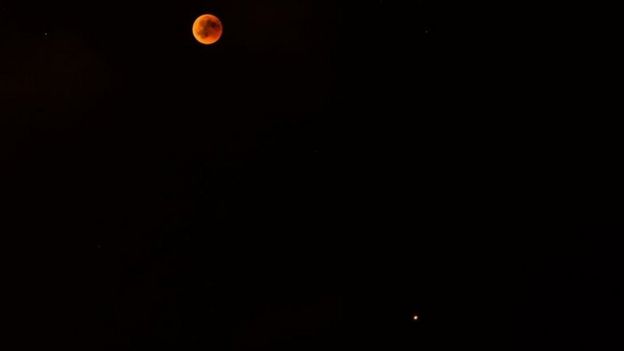
Mars could also be seen as a bright red star just below the Moon.Image copyrightGRAHAM EVAImage captionMars (bottom right) could also be viewed in the sky
"Every couple of years or so, the Earth overtakes Mars on the inside as it orbits the Sun, so Mars is closest to us," said Prof O'Brien.

"And because of the elliptical shape of the orbit, it's even closer than normal."
Where was the eclipse visible?

Where skies were free of cloud, the spectacle was visible almost everywhere around the world, with the exception of North America. The eclipse had already started by the time the Moon rose over the UK and Western Europe.

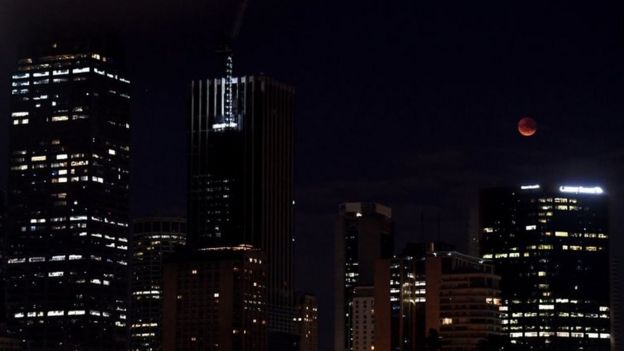
People in the UK needed a clear south-eastern horizon as the Moon came up in order to see it.Image copyrightEPAImage captionThe blood moon over Sydney, Australia
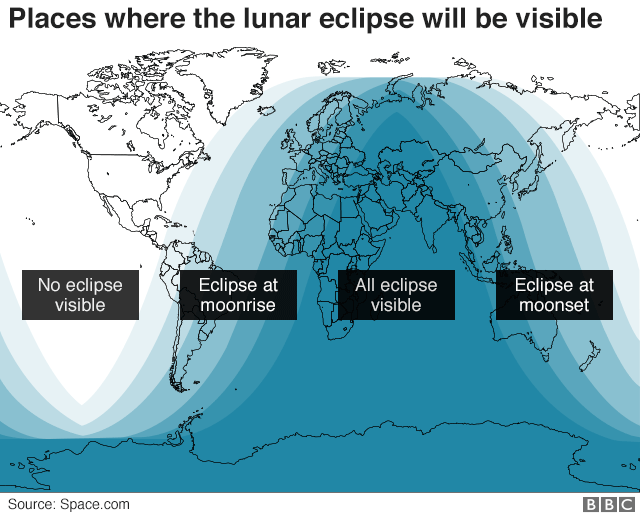
The best views - where the weather permitted - were across Eastern Europe, Central and East Africa and South East Asia, from where the entire eclipse was visible.

So, from the UK and Europe, the south-east was the place to look for the rising, eclipsing Moon with a bright red Mars below. Jupiter could also be seen in the southern sky and Venus in the west.

Dr Emily Brunsden, director of the University of York's Astrocampus, added that this eclipse was a "micro blood moon".

"This is a total eclipse at a time in its orbit when it is close to being the farthest from Earth, or at apogee," she said.

"Hence the Moon was fractionally smaller than usual."

Stages of a total lunar eclipse

Penumbral eclipse begins: This starts when the outer (and lighter) part of the Earth's shadow begins moving across the Moon
Partial eclipse begins: This stage takes hold when the darker, inner part of the Earth's shadow (umbra) begins covering the Moon
Total eclipse begins: Also called totality, this occurs when the umbra completely covers the Moon, turning it a reddish brown colour
Maximum eclipse: The mid-point of totality
Total eclipse ends: The umbra starts moving away from the Moon's face after totality
Partial eclipse ends: Earth's umbra completely leaves the surface of the Moon
Penumbral eclipse ends: The outer part of the shadow (penumbra) completely moves away from the Moon

Sunday, July 22, 2018

Imran Khan near victory in Pakistan election but some ask if he is playing fair

Imran Khan near victory in Pakistan election but some ask if he is playing fair

Former cricket star galvanises support for PTI party with pledge to end corruption
 
Imran Khan gives a speech during a political campaign rally outside Lahore. Photograph: Arif Ali/AFP/Getty Images


On a stage high above a hockey stadium to the north of Lahore, a compere shrieks into the microphone. Supporters of Imran Khan clamber onto rows of chairs. Then the 65-year-old cricket legend steps forward.

With a general election due to be held on Wednesday, the leader of the Pakistan Tehreek-e-Insaf (PTI) is just a bat swing away from a victory he has pursued relentlessly since relinquishing a glamorous London lifestyle of celebrity and nightclubs more than 20 years ago.


“This is an opportunity to change Pakistan,” he tells an 8,000-strong crowd in the poor suburb of Shahdara, as moths collide with high-powered floodlights. “You will not have it again and again.”


Merchants inside the stadium cash in on Khan’s celebrity with T-shirts, phone covers and flags decorated with the craggily handsome features of the “Captain” who led Pakistan to victory at the 1992 cricket World Cup. But it is his promise to end corruption that has transformed the party he founded in 1996, and which held only one seat in parliament until 2013, into the probable leaders of the next government.


Claiming that $10bn (£7.6bn) is laundered out of Pakistan each year, the populist, socially conservative leader hits out at the “traitors who have made this country poor”.


Khan’s political fortunes have risen steadily in the year since he successfully petitioned Pakistan’s supreme court to disqualify the former prime minister, Nawaz Sharif, on corruption charges. Earlier this month, Sharif was imprisoned on a 10-year sentence: from the stage, a PTI official claims that that a jailer switches on Sharif’s television during Khan’s rallies, forcing him to watch his tormentor-in-chief.


“Have you seen Avenfield House?” Mohammed Asif asks outside the rally. “Those are my flats,” says the 33-year-old Khan supporter, referring to four properties in Park Lane, London, which lie at the heart of Sharif’s corruption case. “They belong to the people of Pakistan.”

 Khan supporters at the rally. Photograph: Arif Ali/AFP/Getty Images


But Khan is a deeply polarising figure and his poison-tongued campaign inflamed political tensions. After he called supporters of Sharif’s Pakistan Muslim League-Nawaz (PML-N) “donkeys”, an animal charity reported that PTI aficionados had beaten one of the animals close to death.

Khan implied in a tweet following the deaths of 149 people an Isis-claimed suicide attack on 13 July in the eastern province of Balochistan that the PML-N was behind the attack as a way to distract attention from Sharif’s legal woes. “Beginning to wonder why whenever Nawaz Sharif is in trouble, there is increasing tension along Pakistan’s borders and a rise in terrorist acts? Is it a mere coincidence?” he asked.

More damaging to his claims to represent a break with the status quo is the accusation that Khan is taking advantage of the support of Pakistan’s powerful military establishment, which has ruled the country for nearly half of its coup-studded 71-year history. Polls show the two parties neck-a-neck but PML-N leaders appear so downcast as to have practically conceded.

“Sharif is just crying about the election as this is the first time he hasn’t been able to use his own umpire,” Khan said at the Shahdara rally.


In political terms, Khan has plenty of incentive to seek out shortcuts, according to analysts . The PML-N has had a broadly positive record in government over the last five years, in which the party has notably reduced power blackouts. According to political commentator Fasi Zaka, this means “it would not have been his election” without a military-backed campaign against the party in which supportive media channels have been taken off air, politicians have been pressured to defect, and the courts selectively targeted its leaders.

In a recent interview with Dawn newspaper, Khan lamented that “this is not Europe, you cannot just tell people what you stand for and they will vote for you”. This is a lesson he appears to have learned from the election of 2013, when he worked himself into the ground – eventually falling off stage and being hospitalised.

 People watch a 2013 television interview with Imran Khan in intensive care after he sustained an injury falling. Photograph: Daniel Berehulak/Getty Images


Since then, his campaign has evolved from promises of a “New Pakistan” – better schools, better hospitals, an end to pilfering from the state – into something more traditional. Around one third of his party’s candidates are recently recruited “electables”, long-in-the-tooth politicians who bring with them vote banks and, often, corruption scandals. These characters, many believe, will help the PTI crack the crucial province of Punjab, which returns more than half the 272 directly elected seats in the National Assembly.


But former allies told that many believe that the party has shifted away from its anti-corruption platform. “There are cuckoos in the PTI nest,” Brigadier Samson Sharif, the party’s ex-shadow defence secretary, said. Khan “now has so many albatrosses hanging around his neck … he is a pied piper leading the people nowhere”.


Born in Lahore in 1952, the Oxford-educated cricketer has also undergone what appears to be significant a personal transformation. While he used to party with Mick Jagger, today he defends Pakistan’s strict blasphemy laws and criticises “Westoxified” Pakistani liberals.

In 2017, the provincial government his party has run for the past five years in the northern province of Khyber Pakhtunkhwa granted $3m to the Haqqania madrassa, a fount of Taliban fighters, drawing sighs of “Taliban Khan” from the coffee shops frequented by Islamabad’s liberals. Others note the arc of his marriages: first came Jemima Khan, a glamorous British heiress. Earlier this year Khan secretly wed his spiritual adviser, Bushra Maneka.

Still, the spectre of an electorally poisonous playboy past was revived with the publication this month of a kiss-and-tell memoir by his second wife, Reham Khan, a former news anchor, PDF copies of which were shared far and wide on Pakistani WhatsApp. She alleges he used “six grams” of cocaine a night, has several love-children and sexts women in his party. “She is just a porn star,” says supporter Zulfikar Ali Khan, repeating the argument of PTI insiders that the book’s publication was co-ordinated with the PML-N.

If the book was a ploy, it seems unlikely to pay off. According to Credit Suisse, the PTI stands a 75% chance of forming a coalition government under Khan. Some supporters even celebrate the army’s alleged tilting of the field as proof that the institution is doing its job. “If they are involved, they are in favour of Pakistan,” says Umair Iqbal, 25. “Even if you put down a vote for PML-N,” adds Shehzar, 19, “it will go to PTI. The PML-N has no chance of forming a government as it has no supporting hands.” In reference to the army, he said: “They know how to bowl you out.”


That appears a blessing to Khan for now. But with a looming economic crisis, political instability and an assertive military establishment to handle, Pakistan’s probable next “Captain” will have to zealously guard his own stumps.

Army asks Supreme Court to probe Justice Siddiqui's allegations

Image result for pakistan army


ISLAMABAD: The Pakistan Army on Sunday demanded Supreme Court of Pakistan initiate "process to ascertain the veracity of allegations levelled against state institutions" by the Islamabad High Court judge Justice Shaukat Aziz Siddiqui.

Also read: CJP Nisar responds angrily to Justice Shaukat’s statement

"An honorable judge of Islamabad High Court of Pakistan has leveled serious allegations against state institutions including honorable judiciary and the premier state intelligence agency," said a statement issued by the Inter-Services Public Relations in a statement without naming the judge.

More: IHC CJ approached for choice benches: Justice Siddiqui

The statement said in order to safeguard the sanctity and credibility of the state institutions, honorable Supreme Court of Pakistan has been requested to ascertain the veracity of the allegations and take actions accordingly.

UK agrees to take in some White Helmets evacuated from Syria by Israel


Jordan says it has struck deal for rescuers and families to be resettled in UK, Canada and Germany

 
White Helmet volunteers have rescued thousands of civilians caught up in fighting in the Syrian conflict. Photograph: Mohammed Badra/EPA


The UK is willing to offer asylum to some of the 500 members or relatives of the Syrian volunteer civil defence forces known as the White Helmets who have been rescued from Syria and evacuated to Jordan, the Guardian has learned.

The White Helmets and their families were evacuated by Israeli defence forces on Saturday night, crossing from northern Israel into Jordan at three points. The Israelis had initially put the numbers evacuated at 800, but later the figure was revised downwards by James Le Mesurier, a former MI5 officer who is considered to have founded the group in Turkey in 2013.

He said on Sunday that 422 people were rescued, including 98 White Helmets. As many as 800 others did not manage to escape or chose not to do so.


The Israeli operation was carried out at the request of a number of countries including the UK, the British foreign secretary, Jeremy Hunt, and the international development secretary, Penny Mordaunt, said in a joint statement. Evacuation plans were drawn up after discussions at the recent Nato summit.

Writing on Twitter, the Israeli prime minister, Benjamin Netanyahu, said: “Several days ago President Trump contacted me, as did Canadian prime minister Trudeau and others, and requested that we assist in evacuating hundreds of White Helmets from Syria. These are people who have saved lives and whose lives were in danger. I therefore authorised their transfer via Israel to other countries as an important humanitarian gesture.”

Britain would not confirm reports from Jordan that Germany, Britain and Canada had given a legally binding undertaking to take the refugees within three months, but indicated that the processes established by the United Nations high commissioner for refugees (UNHCR) for the vulnerable persons resettlement scheme was expected to be used to identify those White Helmets eligible to come to the UK.

The German interior minister, Horst Seehofer, told Bild newspaper that Germany would take in eight White Helmets members and their families. The move was “an expression of my stance of ensuring humanity and order in migration policy”, he said.

Canada will take in up to 50 White Helmets volunteers and their families, totalling up to 250 people, the country’s public broadcaster CBC said, citing senior officials.

Canada’s foreign minister, Chrystia Freeland, said she had “called for global leadership to support and help these heroes” at last week’s Nato summit. Other countries are also expected to make offers.

Jordan had been barring refugees from coming over the border from Syria, even though many were under severe bombardment from a joint Syrian-Russian air and ground offensive.
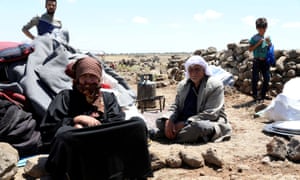
 Syrian refugees fleeing conflict in Deraa province sit near the Israeli-occupied Golan Heights. Photograph: Alaa al-Faqir/Reuters

News of the operation came from the Israeli military, which said that overnight it had completed “a humanitarian effort to rescue members of a Syrian civil organisation and their families ... due to an immediate threat to their lives”.
Advertisement


It said it had acted following an Israeli government directive and at the request of the US and European countries.

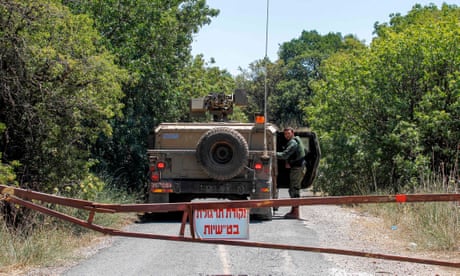
On Saturday, Israeli security forces closed down roads in the occupied Golan Heights on the Syrian frontier before the evacuation operation. The refugees were taken into Jordan across three routes.

Jordan has shut its borders, saying its refugee camps are already full with more than 600,000 Palestinian and Syrian registered refugees, as well as hundreds of thousands of unregistered refugees.

The Syrian government began an offensive in June forcing hundreds of displaced people to take shelter on the Israeli-Jordanian border.

The White Helmets have operated in opposition-held areas rescuing civilians from the rubble of airstrikes, but they have been attacked as western agents by Russia since their work has been funded by the UK Foreign Office (FCO) and the White House. Their footage of the impact of air attacks has also shocked the western world, and revealed the often brutal impact of the Syrian air campaign. More than 250 of its volunteers have been killed in attacks.

Members of the White Helmets were thought likely to be targeted by the Syrian army once it regained control of the south-west part of Syria. The Russian embassy in the Netherlands welcomed their departure, accusing them of making fake allegations of chemical weapons attacks.


Defending the exception granted to the White Helmets, Mohammed al-Kayed, a spokesman for Jordan, said their transfer did not put the kingdom under any further obligations. He said the aid workers would remain at a closed location and that Britain, Germany and Canada had agreed to resettle them within three months.
Advertisement


The FCO said the closed location was under the control of the UNHCR.

Justifying the operation, Hunt and Mordaunt said: “The White Helmets have saved over 115,000 lives during the Syrian conflict, at great risk to their own. Many White Helmets volunteers have also been killed while doing their work – trying to rescue civilians trapped in bombarded buildings or providing first aid to injured civilians. White Helmets have been the target of attacks and, due to their high profile, we judged that, in these particular circumstances, the volunteers required immediate protection. We therefore took steps with the aim of affording that protection to as many of the volunteers and their families as possible.

“We pay tribute to the brave and selfless work that White Helmets volunteers have done to save Syrians on all sides of the conflict.”

Since the White Helmets’ formation at a time when Syria’s conflict was nearing its third year, more than 200 of its volunteers have died and another 500 have been wounded. Some members have received training abroad, including in Turkey, returning to instruct colleagues on search and rescue techniques.

The group receives funding from a number of governments, including Britain, Germany and the US, but also solicits individual donations to purchase equipment such as its signature white hard hats.

The Syrian government and its ally Russia have called the White Helmets terrorists, and have accused them of being agents of foreign powers and of cooperating with radical insurgent groups. Both Moscow and Damascus have also accused the White Helmets of staging rescue missions and chemical attacks to blame on the government.

State media said on Sunday the fact that Israel, with which Syria is formally at war, had facilitated the evacuation was evidence of the group’s collaboration with an enemy power. Al-Ikhbariya, a Syrian state TV channel, called the evacuation a scandal, and the state news agency SANA said “the secret” of the group had been revealed and its “role as an agent ended”.

The Syrian MP Khaled Abboud said that foreign powers “were pulling their agents out of the battlefield” because of the Syrian military victories that had quashed aggression against the country.

The evacuation was the first such Israeli intervention in Syria’s lengthy civil war, now in its eighth year. Although it has sent aid into the country and provided medical treatment to thousands of Syrians who reached the Golan Heights frontier, the Israeli military said its actions did not reflect a change in Israel’s official non-intervention policy in Syria’s war, where all parties to the conflict are considered hostile.
Advertisement


Its forces have also on occasion conducted military strikes within Syria.

Israel seized 460 sq miles (1,200 sq km) of the Golan Heights from Syria in 1967 during the six-day war and later annexed it, a move that has never been recognised internationally.

Syrian forces launched a Russia-backed offensive to retake Deraa and Quneitra provinces from rebels on 19 June. A month later, government institutions look set to return to most of the two provinces through a combination of bombardment and surrenders brokered by Moscow.

The deals provide for rebels to hand over their heavy weapons and those who disagree with a government takeover to be bussed with family members towards opposition-held areas in the north of the country.

Jihadists are not party to the deals and Russian planes bombarded a holdout of Islamic State in Deraa province overnight, a UK-based war monitor said.

More than 20,000 civilians have fled to government-held areas to escape the bombardment of the Isis-held area on the border with Jordan and the Israeli-occupied Golan Heights in the past 24 hours, according to the Syrian Observatory for Human Rights.