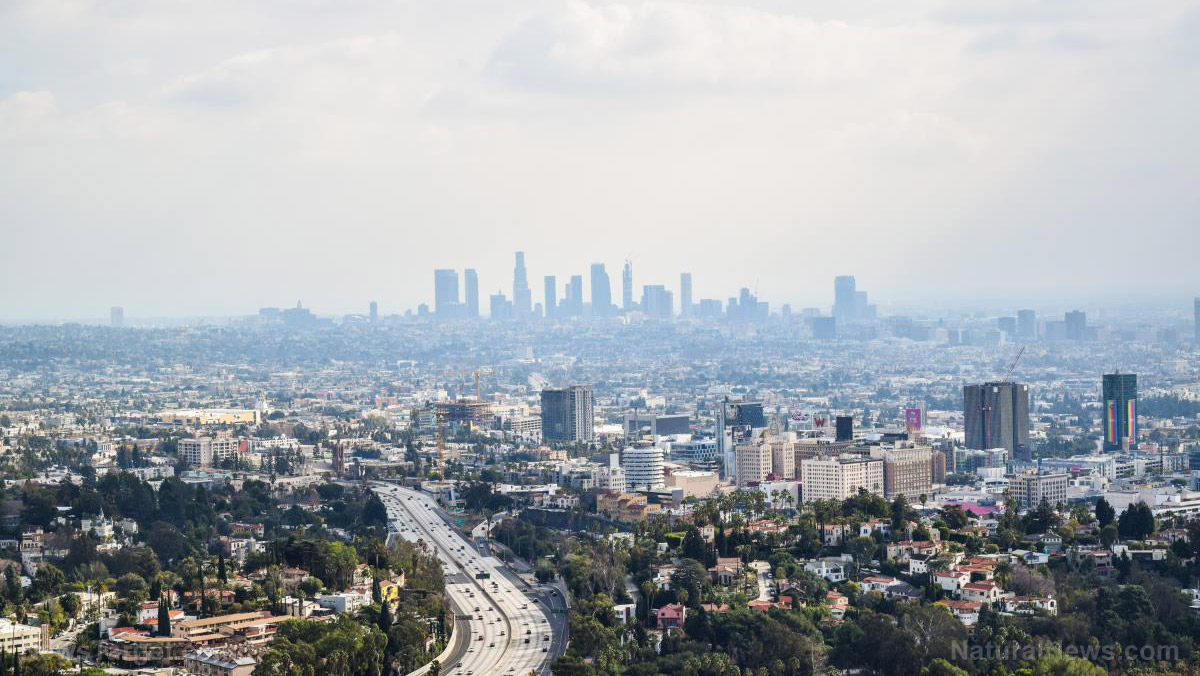
Showing posts with label power grid. Show all posts

Monday, September 11, 2017

California power officials beg customers to stop using air conditioning as West Coast power grid reaches critical failure


A prolonged heat wave that continues to hover over much of the West Coast of the United States is causing record temperature swells throughout California, putting major strain on the Golden State’s power grid. Recent reports suggest that if California residents don’t start cutting back on their energy usage, the power grid could reach critical failure in the coming days.
That’s why California energy officials are urging people throughout the state to bear through the heat as much as they can while using their air conditioners as minimally as possible. The California Independent System Operator, which oversees roughly 80 percent of the state’s electrical grid, has issued a statewide alert about energy conservation that urges Californians to be aware of their energy usage habits and to cut back wherever possible to keep the grid from becoming overloaded.
“Consumers are urged to conserve electricity especially during the afternoon when air conditioners typically are at peak use,” the alert states. “Consumers can help avoid power interruptions by turning off all unnecessary lights, using major appliances before 1 p.m. and after 10 p.m., and setting air conditioners to 78 degrees or higher.”
California ISO also recommends that Californians try to use fans as much as possible and to close their shades and/or drapes during the peak heat of the day. Turning lights and appliances off during these hours is also being advised, as the best times of the day to economize energy usage are during the early morning and late evening when demand is lower.

Southern California experiencing dramatic wildfires worse than anything ever seen in the region

Things seem to be especially bad in Southern California, where a “dangerous” heat wave is persisting unabated. The National Weather Service (NWS) is urging residents to take precaution and be aware of the risks involved. Besides energy shortages, forest fires are a major concern, including in Los Angeles where the worst area wildfire in recorded history continues to cause problems.
Reports indicate that more than 7,000 acres of La Tuna Canyon have already been burned which, combined with ongoing strong winds, isn’t looking too promising for full containment anytime in the near future. However, as of this writing, officials say the fires in La Tuna Canyon are about 90 percent contained. At the same time, local residents are being encouraged to conserve not only electric energy but also natural gas, which officials say could reach short supply.
Despite these warnings, there have been reports of localized power outages in certain areas of Los Angeles County. One report explained that some 9,300 customers went without power as Southern California Edison, the local energy provider, worked hard to restore service throughout the region.
“It is a result of high overnight temperatures, high level of air conditioning use and just overall demand on the system,” stated Robert Villegas from the energy utility to reporters. “Here in Southern California, we have 5 million customers, so a little tiny bit of conservation from each of those customers really adds up and can really help shape the peak demand.”
This is hardly the first time that Californians have had to be frugal with their energy usage. Back in 2012, California ISO issued a similar flex alert about conserving energy as high temperatures at that time placed an immense burden on the energy utility systems to keep up with demand.
During this particular heat wave, temperatures were exceptionally high even along the coastline, which in California is typically blanketed in cool breezes throughout the summer months. That year was different, though, as excess heat pushed to the limits the capacity of California’s energy grid.
Sources for this article include:

Monday, July 31, 2017

Why you can no longer put off prepping for hacks and takedowns of ALL U.S. infrastructure


Unbeknownst to most Americans, there is a conference that takes place in Las Vegas every single year that draws the most competent, capable hackers in the world. For four days they meet to discuss and demonstrate the latest techniques they’ve discovered (and likely used) to essentially disrupt as much of modern society as possible.
In the digital, wired, Internet-connected age, in a single room, at a single convention, lies the fate of modern societies everywhere.
The event is called “Black Hat,” and it just concluded last week. This year’s event drew about 16,000 hackers and information security experts from all over the world, as lawmakers, policymakers, defense experts, financial institutions, power companies and other infrastructure managers lie awake at night trying to figure out how to defend modern IT systems from these folks.
Hackers routinely come to the Black Hat convention to demonstrate how to break into electronic systems embedded in medical devices, ATMs, cars, routers and mobile phones. This year, at the 20th annual gathering, one security researcher walked attendees through a hack of a wind farm.
“Wind farm control networks are extremely susceptible to attack,” said the researcher, Jason Staggs, who works on behalf of the University of Tulsa.
He says hackers only need to find access to a single wind turbine in order to implant a virus or malware that would then spread throughout the wind farm. He said he’d been able to hack into multiple wind farms, after first obtaining permission from the operators.
“We can turn the turbine on or the turbine off or put it in an idle state,” he told the gathered attendees, as he then demonstrated his technique.
At present, wind farms provide less than 5 percent of America’s energy needs, but industry experts believe that will climb to 20 percent by 2030, so you can see that the risk to the country’s energy infrastructure is only going to grow.
Staggs said that a 250 megawatt wind farm standing idle after a malicious cyber attackcan cost an electric utility between $10,000 and $35,000 an hour.
Then, of course, there are fears of attacks on the nation’s power grid itself, such as that which occurred in Ukraine in December 2015, allegedly by Russian hackers. And while some U.S. experts say that hacking the American grid is difficult because there are actually several of them and they are robust, a targeted attack in a densely populated region is very possible.
“If somebody really wanted to send a message, it hurts to have three or four days of no power to the Eastern Seaboard,” Sam Curry, the chief product officer at Boston-based firm Cybereason, told McClatchy DC. “That could be done. And there’s no quick fix.”
Now, imagine if that hack happens in the dead of an East Coast winter; the casualty rate could be enormous. (Related: U.S. Power Grid Continues To Be Vulnerable To Cyber Attack: Millions Would Die If It Were To Fail, So Are You Prepared?)
Worse, some cyber security experts believe that non-state actors or nation-states have already planted malicious code throughout the nation’s infrastructure. One of them is Jay Kaplan, a former member of highly selective counterterrorism cyber unit at the National Security Agency.
“I do believe that there is a certain percentage of our critical infrastructure that’s already compromised,” said Kaplan, now CEO of Synack, a California-based firm that sends security teams to hack into clients’ networks to test for vulnerabilities.
“This is prepositioning,” he told the McClatchy news service. “Should we ever go to war with another nation state, they can leverage this malware for their benefit and basically cripple the economy. I just think it’s reality; right now I don’t feel confident at all.”
So neither should you.
If you’ve not begun a prepping program yet, or if you’ve neglected an existing program, you really shouldn’t be wasting time thinking about it.
J.D. Heyes is a senior writer for NaturalNews.com and NewsTarget.com, as well as editor of The National Sentinel.
Sources include:

Sunday, June 11, 2017

Smart Meters’ claimed cost efficiency benefits are mostly BUNK, analysis finds

Image: Smart Meters’ claimed cost efficiency benefits are mostly BUNK, analysis finds

Compared to any other province, people living in Ontario pay steeper rates for their power. According to The Globe and Mail, electricity prices in Ontario have soared in the past decade, rising four times as fast as inflation. Despite the use of the term “hydro” as a synonym for electricity, Ontario relies on a mix of energy sources to power the grid. Nearly 60 percent of the electricity comes from nuclear power plants and about 24 percent comes from hydroelectricity.
Today, Ontario’s electricity system is a tangle of public, private, and semi-private companies, hence its hefty price tag. In an attempt to reduce energy consumption during peak periods and slash electricity costs, smart meters and time-of-use rates were introduced in November 2011.
Unfortunately, Ontario’s $1 billion smart meter program has delivered few benefits for the hefty electricity cost, new research conducted at the University of Waterloo in Canada reported. Their analysis was recently published in the journal Energy Policy.

Are smart meters worth the $1 billion investment?

The power supply can be divided between “baseload” and “peaking” power. While baseload generation of electricity is a continuous process providing the grid with a steady stream of power, peaking power is only switched on when needed.
Smart meters allow electricity companies to charge different prices at different times of the day. Smart meters were supposed to encourage energy savings, especially during peak times when the grid is under much more stress. One of the key goals of Ontario’s smart meter project was shifting the demand for electricity away from peak periods to reduce maximum capacity requirements and save money on infrastructure, reported Science Daily.
Unfortunately, these smart meters aren’t the “smarter” solution. In fact, smart meters could be overbilling you by an astonishing 582 percent while destroying your health.
After comparing data of nine months before and nine months after smart meters and time-of-use (TOU) rates were introduced in Ontario in November 2011, researchers concluded that the new pricing system only has a modest impact on reducing peak demand and energy savings.
To come to that conclusion, the Waterloo researchers used a set of smart meter data of over 20,000 households. The authors of the study did not disclose the name of the electricity company that provided the data.
The data contained measurements from the summer before and after the implementation of TOU pricing in November 2011. Using advanced statistical tools to factor out the impact of weather differences, their analysis showed that the residential demand for electricity dropped only 2.6 percent during on-peak periods and 2.4 percent during mid-peak periods following the change.
“There is a gain, but the gain is very small,” said Lukasz Golab, a management sciences professor and Canada Research Chair at Waterloo.
Is this futile gain enough to justify the initial $1 billion investment? A delicate question Professor Golab doesn’t dare to answer. He noted that his team’s findings don’t offer any insights whether the savings thus far made the cost of installing smart meters worthwhile.
“Is it enough? Of that I’m not sure. We don’t have the data to decide if these kinds of savings warrant the use of smart meters,” said Catherine Rosenberg, a Canada Research Chair at Waterloo and professor of electrical and computer engineering.
Furthermore, the study authors also suggested that time parameters used to set the different rates may not be aligned properly for residential customers. The summer on-peak period on weekdays is set from noon to 5 p.m., but according to the data used by the Waterloo researchers, the demand hit its highest point at 6 p.m.
Sources include: