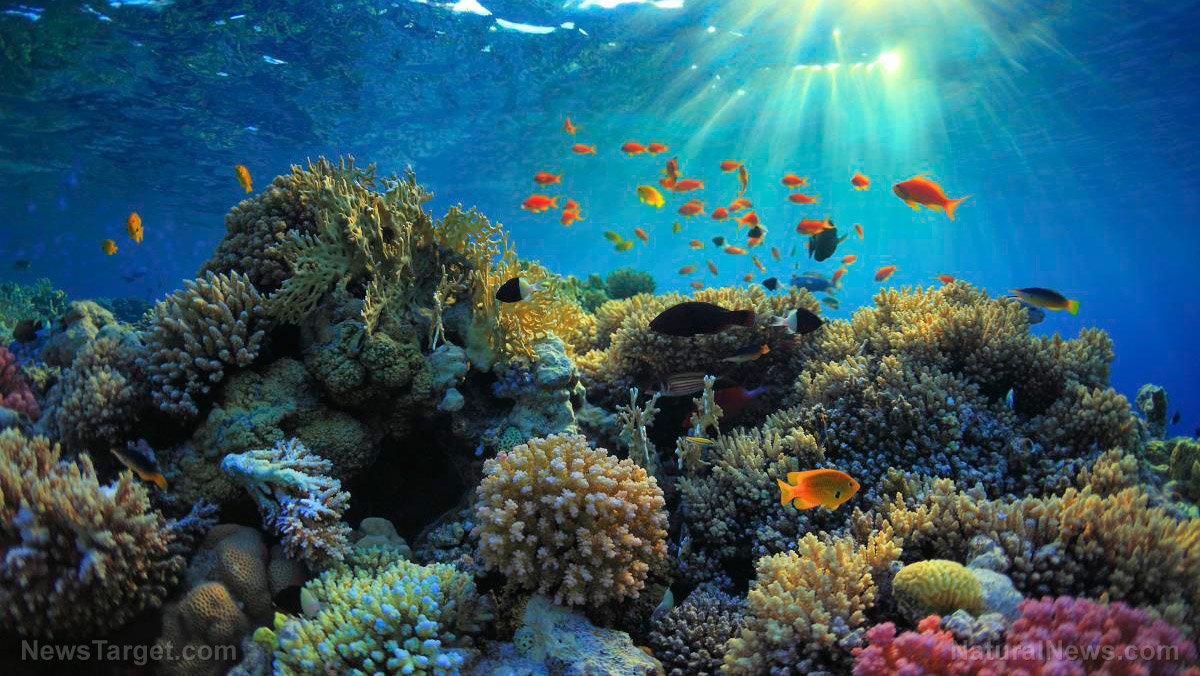
Ocean acidification is a phenomenon that has been associated with increased dangers for species of fish, such as leaving them unable to flee from predators and enemies. This chemical reaction is the product of boosted carbon dioxide uptake from the atmosphere and results in seawater undergoing fundamental changes to its chemistry. However, a team of researchers have uncovered a surprising fact about ocean acidification: it may not be as bad as initially thought, and fish may in fact be less affected than previously believed.
The researchers used the facilities of James Cook University and the National Sea Sim Simulator at the Australian Institute of Marine Sciences to imitate a coral reef environment and its natural conditions. They managed to simulate water conditions that occurred naturally and that which is affected by human influence.
By subjecting clownfish and juvenile damselfish to changing levels of carbon dioxide, the researchers noticed that the fishes’ behavior varied depending on the conditions there were exposed to as they matured. As the researchers discussed in their study, the fish who were raised in stable carbon dioxide levels exhibited strange behavior when the carbon dioxide levels changed. Conversely, the fish who were exposed to conditions with changing carbon dioxide levels did not.
Moreover, the researchers discovered that the carbon dioxide levels surrounding coral reefs did not remain constant and were much lower during the day than at night. “Shallow water habitats where reef fish live can experience substantial natural fluctuations in water chemistry throughout the day,” said senior author Professor Philip Munday.
Lead study author and James Cook University PhD student Michael D. Jarrold added: “Our data suggest that these natural daily changes in water chemistry are enough to provide fish with a recovery period, reducing their sensitivity to higher carbon dioxide levels.”
Regardless of exposure, however, carbon dioxide levels at 1000 microatmospheres were found to affect the behaviors of all fish, meaning that there was a limit to the amount of carbon dioxide that fish could tolerate.
Still, the researchers have expressed joy about the outcome of their study. Speaking to ScienceDaily.com, Jarrold remarked: “We are thrilled about what we’ve found. Our results provide a greater level of optimism for reef fish populations in the future.”
More than just making it clear that carbon dioxide won’t be the end of all sea life, the researchers have also absolved “climate change” as the primary cause of ocean acidification. It’s a naturally occurring phenomenon, so how can its cause be pinned entirely on “climate change”? Fact is, it can’t. Constantly shifting carbon dioxide levels aren’t all that uncommon, and so many forms of sea life have acclimated to them with little issue. (Related: Ten alarming, REAL threats to the environment that are widely ignored by “climate change” advocates)
Go to Enviro.news for more stories that are like this one.
Marine experts from the California State University recently pointed out that microplastic pollution has steadily become a major threat to the world’s oceans. According to the experts, microplastics are especially problematic as they are more challenging to manage due to their microscopic size. Microplastics, which measure less than five millimeters, are degraded plastic fibers that end up in the oceans. The researchers cautioned that marine creatures may readily ingest these microplastics as they could mistake them for food.
“Marine debris is everywhere; it’s on the surface of the ocean, it’s on our beaches, and its presence is increasing. We’re seeing more [marine debris] in our oceans now than in the past. The thing that is most disturbing to me is the not the ‘macrodebris’ that we can easily see with our eyes; it’s the ubiquity of microplastics that has completely blown me away. Microfibers and microplastics can displace critters’ natural food and natural behavior. The critter may need to work more and use more energy; it may block their intestinal tracts,” said marine expert Sean Anderson.
“Trash in the ocean, including significant amounts of microplastics, is a pervasive and significant problem in the waters off California as well as around the world. Microplastics are particularly concerning because of their ubiquitous distribution and disastrous impacts on marine life. [Micro plastics] act like a sponge, soaking up additional pollutants from the surrounding waters, only to leach them back out again, oftentimes into animals that have ingested the plastics. This leads to accumulation of toxic chemicals in marine life, even in situations where the animals are far from humans,” marine researcher Krista Kamer said in ScienceDaily.com.
In order to study the effects of microplastics on marine life, Anderson and his team examined digestive systems of multiple crab species along California’s coast. The researchers found that a majority of the species ingested microplastic fragments. In fact, one organism even showed nearly 100 fragments of microplastics in its system. However, the marine experts stressed that more studies are needed to better determine the effects and reach of microplastic pollution.
U.N. report reveals microplastic contamination in fish
Data from the United Nations (U.N.) Environment Project report revealed that more than a quarter of all fish sold around the world were contaminated with microplastics. To carry out the research, a team of researchers examined intestine samples from fish sold at markets in California and Indonesia. The researchers cautioned that consuming high quantities of marine food contaminated with microplastics may cause adverse medical conditions in humans.
The report also warned that people might be breathing in microplastics suspended in the air, which in turn may lead harmful effects similar to car fumes. According to the report, several areas around the world show higher levels of microplastic pollution. East Asia, for instance, was found to have 27 times more plastic particles in the oceans compared with other parts of the world. The report also noted that microplastic pollution may even affect significantly far places such as deep sea sediments and a Mongolian mountain lake. The report was presented last year at the U.N. Environment Assembly in Nairobi, Kenya.
A team of researchers from the Institute of Geodesy and Geoinformation at the University of Bonn in Germany are currently developing a robotic tool that readily identifies weeds and shoots laser to eliminate them, thus reducing the need to use herbicides. The project received an EXIST Business Start-up Grant from the Federal Ministry for Economic Affairs and Energy.
The robotic system is slated to use deep learning algorithms to carry out the weeding task. The researchers also look into the possibility that the system might require cameras mounted on an all-terrain robot vehicle to do the weeding. The system might also serve as an add-on equipment to tractors for the same reason. According to researcher Dr. Julio Pastrana, the robotic system will shoot the leaves of unwanted weeds with short laser pulses, which in turn will weaken their vitality. Using the robotic system may potentially reduce the need for herbicides on fields, thus protecting the environment, said researcher Tim Wigbels.
The researchers are currently working on the specifics of their robotic system, and are also moving to establish their startup business Escarda Technologies for one year at the university through the EXIST grant. “It is now a case of finding investors and further developing the business plan for the start-up,” Wigbels noted in Science Daily. Both researchers look into participating in the start-up round tables carried out by Technology Transfer. “Our aim is to contribute to achieving more sustainable agriculture,” Pastrana quoted in United Press International. The laser-blasting technology may have legitimate commercial potential, said transfer advisor Rüdiger Wolf.
Potential implications in herbicide use
The development of the new robotic system may have positive implications in herbicide use around the world, which has shown significant growth over the years. In fact, a study published in 2015revealed that the U.S. has already applied a whopping 1.6 billion kilograms of the herbicide glyphosate since 1974. This accounted for 19 percent of estimated global glyphosate use.
According to the study, two-thirds of the total glyphosate volume applied in the U.S. between 1974 and 2014 has been used during the past decade alone. This accounted for 72 percent of the global glyphosate use. The researchers also found that in 2014 alone, farmers used enough glyphosate to apply 1.0 kg/ha on every hectare of cultivated cropland across the U.S. and nearly 0.53 kg/ha on all cropland around the world. (Related: Glyphosate contamination might be apparent in food too)
In addition, the study showed that the global glyphosate use showed a 15-fold increase since 1996, around the same time when genetically engineered, glyphosate-tolerant crops were introduced.
“Genetically engineered herbicide-tolerant crops now account for about 56 percent of global glyphosate use. In the U.S., no pesticide has come remotely close to such intensive and widespread use. This is likely the case globally, but published global pesticide use data are sparse. Glyphosate will likely remain the most widely applied pesticide worldwide for years to come, and interest will grow in quantifying ecological and human health impacts. Accurate, accessible time-series data on glyphosate use will accelerate research progress,” the researchers concluded in Environmental Sciences Europe.
As a popular tourist trekking destination, abandoned garbage has become a problem for the world’s highest peak. Discarded cooking and oxygen cylinders, food packets, and tents are just some of the items that continue to litter the face of the mountain. As OurWorld.unu.enu notes, there is still no method of efficiently managing solid waste during climbs. Expedition members who need to empty their bowels did so wherever they could. This means that several decades’ worth of human excrement may still be buried underneath the white snow caps.
“Discarded in ice pits, the human waste remains under the snow,” Ang Tshering Sherpa, chief of the Nepal Mountaineering Association, has said. “When washed down by glaciers (when the snow melts), it comes out in the open.” In previous years, mountaineers have removed close to 16 tons of garbage from Mount Everest.
What is being done now
As climbing season opens for the Himalayas, the Nepalese government and Everest expedition organizers have joined forces to clean up the garbage littered across the different elevations of Mount Everest. A series of destructive avalanches over the years have led to climbers abandoning their sites and their supplies. These are what the sherpas and other climbers will be cleaning up this year, reported TheGuardian.com.
Each volunteer will be given 10 canvas bags capable of holding 80kg (176lbs) of waste. Once the bags have been filled, they will be winched by helicopters and flown down. This way of removing the sacks of garbage is cheaper, safer, and more efficient. “This way we hope to bring down the trash without any extra cost,” Durga Dutta Dhakal, an official for the Nepal tourism department, told Reuters.com.
Recreational climbers are also encouraged to pick up any junk they find along their routes; sherpas will be paid an extra US$2 by veteran climber Russel Brice for every kilogram of trash they bring down with them.
Other problems
Water scarcity and water pollution have also become increasing problems for the Himalayas. The combination of human and animal waste has contaminated freshwater sources. (Related: A Struggle for Water Resources in the Himalayas)
In response to the alarming amount of refuse, the Nepalese government has enforced stricter penalties to require climbers to clean up after themselves. A 2014 ruling stated that any climber who failed to return from an expedition with 8kg (17.6lbs) of trash and human waste would be fined US$4,000, reports BusinessInsider.com.
Even with such efforts being carried out, the question remain: is it enough? In the last year alone, more than 600 people scaled Mount Everest through Nepal and China. Officials estimate the number to grow in the coming season. That’s at least 600 people who have equipped themselves with supplies and gear intended to last them for months. Though there are policies and penalties already in place, enforcing them on all these climbers and subsequent generations will be an exhausting endeavor.
Not even the lower regions of the Himalayas are free from the presence of people. The Everest Base Camp (EBC) hike is a trekking route that continues to bring in tourists demanding more comfortable services. With the construction of mountain lodges comes environmental damage like soil erosion.
The Himalayas may not be fully open to tourists and climbers all year round, but the impact they have on the peaks and base camps can last for years and even decades.
Learn more about the effects our actions have on our environment by visiting Enviro.news.
The image of Markus Siivola was taken by photographer Michael Davies, who gave BuzzFeed some background on the location and what went into capturing the amazing shot.
It’s pretty cold in the north of Canada at any time of year, but in the winter, temperatures plummet to incredible lows. Ontario-based photographer Michael Davies and his friend Markus stood at the top of a mountain and demonstrated this by throwing leftover tea into the air, dramatically photographing it instantaneously freezing.
This mountaintop was just 20 kilometers (12.4 miles) south of the Arctic Circle, and fairly close to Pangnirtung, the fly-in community where Davies has worked as a photographer for the last decade. With weather around -35°C (-31°F), the tea – kept hot within the thermos flask – froze before it had even begun to fall to the snowy ground.
The winter months in Pangnirtung are as frigid as they are dark. “Between sunrise and sunset we only have 2.5 hours of light,” he explained to IFLScience. In order to get this incredible shot, some natural light was required; he drove on a skidoo to a nearby mountain where the light, which is almost always pink near the winter solstice, would hit the ground.
Nothing was left to chance. “I followed the temperature, I watched for calm wind, planned the shot and set it up,” Davies told IFLScience. “Even the sun in the middle of the spray was something I was hoping for, even though it’s impossible to control.”
The results were these one-of-kind images that can only happen at a handful of places on Earth.
There’s a peculiar phenomenon occurring in the frozen lakes of the world: Strange circles are cropping up in the ice, and some believed it was the winter version of an alien-made crop circle. However, scientists have recently explained that the shapes are merely ice circles, which crop up after methane emissions create a rising mass of warm water under the surface.
A strange video is kicking up a storm online, appearing to show a bizarre dark circle in the middle of a frozen lake. The phenomenon, which occurred somewhere in Utah, appears to have large ice crystals embedded throughout.
As you might expect, numerous theories and guesses have been thrown around, including a rare fungus, fish blood, a viral marketing campaign or students making a prank video. However, one of the more credible sounding explanations suggests it could be the effect of an organism’s natural antifreeze protein. These could interfere with the crystallization of the ice, causing the formation of the odd-looking structures.
The guys in this video discovered a strange something in the middle of a frozen Utah lake. Naturally, they start poking at the object with their bare hands because no one heeds the lessons of sci-fi or horror movies.
A nearby takeaway coffee cup, which you can see in the video, is also a prime suspect.
A Colorado weather station observed a record low of -51°F only weeks after politicians met in Paris to combat “global warming.”
The Antero Reservoir station, located about 100 miles southwest of Denver, said the temperature was the third lowest the station has recorded in over 50 years.
“It was verified with another thermometer, both of which have been inspected and approved by the National Weather Service,” said spokesperson Travis Thompson, Sr.
The last time the temperature was as low was on Feb. 8, 1989.
Although the Antero Reservoir has been described as a “extreme microclimate” due to the surrounding mountains keeping cold, dense air from escaping, nearby Buena Vista, Colo., which is at least 1,000 feet lower, recorded a low of zero degrees on the same date.
Now does that really sound like “global warming?”
Other areas of the globe are also experiencing extreme cold.
“Over the past month, there has been a large surge in Arctic ice growth, leading to the largest extent for the date since at least 2004,” Climate Depot reported. “This went on all through [the Paris Climate Conference] – where tens of thousands of criminals met in an effort to steal your money, freedom and energy security.”
That’s the key point: politicians are deliberately arousing public fear over “global warming” to expand the size and scope of government as their “solution” to combat “man-made climate change.”
And when prominent “global warming” advocates such as Al Gore were called out for their failed predictions that the polar ice caps would have melted by now, they simply replaced the phrase “global warming” with “man-made climate change” while still demanding carbon taxes and more government regulation.
“Accuracy in these predictions would not be important; their purpose would be to frighten, not inform,” G. Edward Griffin wrote.
If someone told you there is a Silicon Valley start up selling bottled air to China, you would probably think it’s a joke. And it is; the start up is actually in Alberta, Canada.
Yes, you read that correctly. Vitality Air, a start-up in Alberta, Canada, is capturing fresh, pollution-free air from the Rocky Mountains and selling it for up to $32 CAD a bottle. They have launched a successful campaign to market their product – well, nature’s product – to China, a country whose population is suffering from severe air pollution. Over 4,000 units will be on their way across the ocean soon, 1,000 of which are already pre-sold. And again, you read that all correctly: bottled air is on its way to China.
Vitality Air describes their process of capturing fresh air from Banff National Park and Lake Louise as using a clean compression system to collect large batches of air, which is then transferred to individual aluminum cans at their headquarters. Each bottle comes with a spray cap or built in mask for taking in the fresh air, as well as a certificate of authenticity. The website touts the bottled air as perfect for hangover recovery, athletic performance, cramming for exams, and even marathon video gaming.
But the biggest appeal seems to be among Chinese residents, 80 percent of whom are living in conditions which exceed the US Environmental Protection Agency’s standards for acceptable air pollution levels. It is estimated that 4,000 Chinese citizens die every day from pollution, which causes 17 percent of overall deaths in the country. It certainly is not hard to understand the allure of bottled air from a pristine mountainside when considering these statistics. The company recently tweeted: “China declared red alert for #smog.
Need a breath of fresh air? Check out our products! #ChinaSmog.”
You tell us – how we should look at Vitality Air? Helpful service to those in need or opportunistic maneuver?
After shipping 500 sample bottles to China, Vitality Air suddenly found itself with an unmatched demand for its product. Currently, the company has a shipment of 4,000 set to make its way to the country, with over 1,000 of them already pre-sold.
Vitality Air hasn’t been shy about targeting those in need. On Twitter, the company sent off an onslaught of tweets targeting people in or visiting China.
In Russia, in the Caucasus mountains, not far from the cities Tzelentzchik, Touapse, Novorossiysk and Sochi, there are hundreds of megalithic monuments. The Russians call them dolmens. Russian and foreign archaeologists have not yet discovered their use. All these megalithic dolmens you see below in the pictures are dated from 10,000 years to 25,000 years ago, according to the website Kykeon. Other archaeologists put the age of these megalithic structures at 4000 to 6,000 years old.
Thousands of prehistoric megalithic monuments are known throughout the world. Some of the least known outside the former Soviet Union, however, are those in the Caucasus. These dolmens cover the Western Caucasus on both sides of the mountain ridge, in an area of approximately 12.000 square kilometers of Russia and Abkhazia.
The Caucasian dolmens represent a unique type of prehistoric architecture, built with precisely dressed cyclopic stone blocks. The stones were, for example, shaped into 90-degree angles, to be used as corners or were curved to make a perfect circle. The monuments date between the end of the 4th millennium and the beginning of the 2nd millennium B.C.
While generally unknown in the rest of Europe, these Russian megaliths are equal to the great megaliths of Europe in terms of age and quality of architecture, but are still of an unknown origin.
The Caucasian dolmens represent a unique type of prehistoric architecture, built with precisely dressed large stone blocks. The stones were, for example, shaped into 90-degree angles, to be used as corners or were curved to make a circle.
In spite of the variety of Caucasian monuments, they show strong similarities with megaliths from different parts of Europe and Asia, like the Iberian Peninsula, France, Great Britain, Ireland, Netherlands, Germany, Denmark, Sweden, Israel and India. A range of hypotheses has been put forward to explain these similarities and the building of megaliths on the whole, but still it remains unclear.
Approximately 3,000 of these megalithic monuments are known in the Western Caucasus, but more are constantly being found, while more and more are also being destroyed. Today, many are in great disrepair and will be completely lost if they are not protected from vandals and general neglect.
The dolmens are found in the area of Krasnodar. Krasnodar is a city and the administrative center of Krasnodar Krai, Russia, located on the Kuban River about 148 kilometers (92 mi) northeast of the Black Sea port of Novorossiysk.
Concentrations of megaliths, dolmens and stone labyrinths have been found (but little studied) throughout the Caucasus Mountains, including the Abkhazia. Most of them are represented by rectangular structures made of stone slabs or cut in rocks with holes in their facade. These dolmens cover the Western Caucasus on both sides of the mountain ridge, in an area of approximately 12.000 square kilometres of Russia and Abkhazia.
The map above shows locations of known Dolmen structures. The original source for the following images came via a Russian Website
Map of dolmen locations
The dolmens have a limited variety in their architecture. The floor plans are square, trapezoidal, rectangular and round. All of the dolmens are punctuated with a portal in the center of the facade. While round portholes are the most common, square ones are also found. In front of the facade is a court that usually splays out, creating an area where rituals possibly took place. The court is usually outlined by large stone walls, sometimes over a meter high, which enclose the court. It is in this area that Bronze and Iron Age pottery has been found – which helped date these tombs -, along with human remains, bronze tools and silver, gold and semi-precious stone ornaments.
The repertoire of decoration for these tombs is not great. Vertical and horizontal zigzags, hanging triangles and concentric circles are the most common motifs. One decorative motif that is quite common is found across the top of the porthole slab. It can best be described as a lintel held up by two columns. Pairs of breasts, done in relief, have also been found on a few tombs. These breasts usually appear above the two columns of the porthole decoration. Perhaps related to these are the stone plugs, which were used to block the porthole, and are found with almost every tomb. They are sometimes phallic-shaped.
Some unusual items associated with dolmens are big round stone balls, double balls and animal sculptures.
Dolmen pyramid in Mamed canyon
One of the most interesting megalithic complexes – group of three dolmens – stands in a row on a hill above Zhane River on the Black Sea coast in the Krasnodar area near Gelendzhik, Russia. In this area there is a great concentration of all types of megalithic sites including settlements and dolmen cemeteries. Large stone mounds surrounded the two monuments.
The central dolmen is rectangular in plan, 4 x 4 meters, while the two flanking dolmens are circular, 4 and 5 meters in diameter. The two round dolmens had been bulldozed – probably in the 1950s – in order to harvest the surrounding trees, but the main structure of the central dolmen had not been damaged.
Another (fourth) dolmen near the Zhane River has a secret entrance at the back of the chamber, and a façade, dummy entrance and courtyard at the front of the dolmen. There in addition to these pristine dolmens were some ruined dolmens.
The dolmens have a limited variety in their architecture. The floor plans are square, trapezoidal, rectangular and round. All of the dolmens are punctuated with a portal in the center of the facade. While round portholes are the most common, square ones are also known. In front of the facade is a court that usually splays out, creating an area where rituals undoubtedly took place.
The court is usually outlined by large stone walls, sometimes over a meter high, which enclose the court. It is in this area that Bronze and Iron Age pottery has been found – which helped date these tombs -, along with human remains and bronze tools and silver, gold, and semi-precious stone ornaments. The repertoire of decoration for these tombs is not great.
Vertical and horizontal zigzags, hanging triangles and concentric circles are the most common motifs. One decorative motif that is quite common is found across the top of the porthole slab. It can best be described as a lintel held up by two columns. Pairs of breasts, done in relief, have also been found on a few tombs. These breasts usually appear above the two columns of the porthole decoration.
Perhaps related to these are the stone plugs which were used to block the porthole and are found with almost every tomb. They are sometimes phallic-shaped. Some unusual items associated with dolmens are big round stone balls, double balls and animal sculptures.
The Caucasian dolmens were originally built in harmony with the natural landscape
A long-term project to stody the dolmens ha been sponsored and administered by the Institute for Study of Material Culture History, Russian Academy of Sciences, St.Petersburg, since 1997
The Project was supported by Russian Ministry of Culture (1998-2006); the State Committee for Protection of Cultural Heritage (Krasnodar area, Russia) (1998-2006); Russian Fund for Humanities (1999-2002, 2006); The Fund of the President of Russia (2001); National Geographic, Committee for Research and Exploration (2001, 2003)
NASA’s Kepler Space Telescope recently discovered an Earth-like planet orbiting a nearby star within the habitable zone of our galaxy. Kepler-186f is approximately 500 light-years from Earth in the Cygnus constellation.
The habitable zone, also known as the Goldilocks zone, is the region around a star within which planetary-mass objects with sufficient atmospheric pressure can support liquid water at their surfaces. While it has been estimated that there are at least 40 billion Earth-sized planets orbitingin our Milky Way Galaxy, this particular discovery is labeled the first Earth-sized planet to be found in the habitable zone of another star.
WHAT DOES THIS MEAN?
In addition to Kepler-186f, there are 4 other planets that orbit a nearby star within the Kepler-186f system. What this means is that if the nearby star to this planet is similar to our Sun, then the probability of life on this planet exponentially rises.
“We know of just one planet where life exists – Earth. When we search for life outside our solar system we focus on finding planets with characteristics that mimic that of Earth,” said Elisa Quintana, research scientist at the SETI Institute at NASA’s Ames Research Center in Moffett Field, Calif., and lead author of the paper published today in the journal Science. “Finding a habitable zone planet comparable to Earth in size is a major step forward.”
The nearby star to Kepler-186f has half the mass and size as our solar system’s Sun and only receives one-third of the energy that we receive from our Sun. Kepler-186f orbits its star once every 130 days.
An attorney for the SHAKA Movement in Hawaii that has been trying to uphold a democratically voted moratorium on GMOs on the island of Maui has reportedly said that residents and activists have won – an intervention in a federal lawsuit that was brought on by Monsantoand Dow trying to push their genetically modified agenda on islanders will not go through.
In other words, “proponents of the recently passed GMO Initiative on Maui have been given the green light to intervene in a federal lawsuit challenging the measure.”
“Honolulu attorney Michael C. Carroll, who is representing the authors of the Maui GMO initiative tells Maui Now that the group won standing on Monday to intervene in the lawsuit filed by Monsanto which seeks to delay any enforcement of the measure and ultimately to have it declared unenforceable.”
The federal lawsuit filed last month against Maui County by Monsanto Co. and a unit of Dow Chemical Co. thankfully flew over judge, Barry Kurren, who has deep ties with Monsanto, Dow, and Big Ag. The judge has recently overturned a democratically voted initiative to limit GMOs on the Big Island of Hawaii. Without an upswelling of public pressure, he could have done the same in Maui.
Kurren previously ruled that laws instigated by Kauai and Hawaii banning GMOs were not applicable because the state, not the counties, had jurisdiction over the issue. Dow and Monsantowere hoping that Kurren would rule similarly on the recent ban on GMOs passed in Maui.
Likely due to pressure concerning his questionable allegiances, Kurren reassigned the Maui case to Chief Judge Susan Oki Mollway. It is also due to the fact that both the plaintiffs and defendants had agreed earlier to allow a magistrate judge to try the case. Once the SHAKA Movement found out Kurren’s ties to biotech, they withdrew their approval for Kurren to preside over the case.