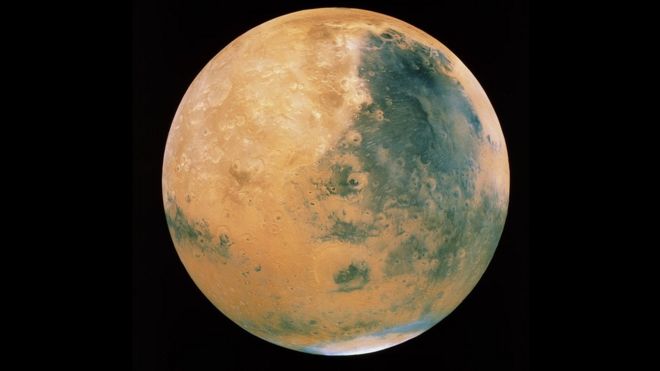
Showing posts with label science. Show all posts

Monday, July 30, 2018

Liquid water 'lake' revealed on Mars


Researchers have found evidence of an existing body of liquid water on Mars.

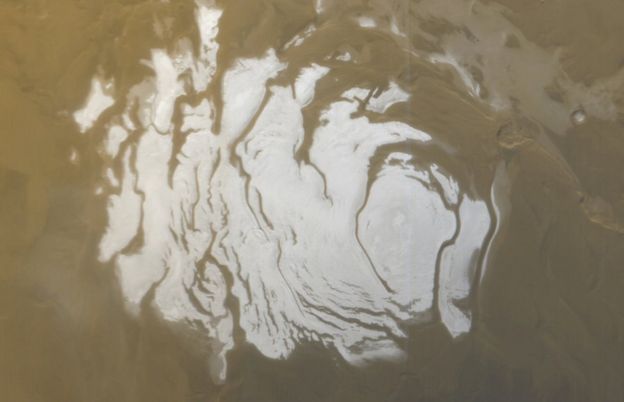
What they believe to be a lake sits under the planet's south polar ice cap, and is about 20km (12 miles) across.

Previous research found possible signs of intermittent liquid water flowing on the martian surface, but this is the first sign of a persistent body of water on the planet in the present day.

Lake beds like those explored by Nasa's Curiosity rover show water was present on the surface of Mars in the past.

However, the planet's climate has since cooled due to its thin atmosphere, leaving most of its water locked up in ice.

The result is exciting because scientists have long searched for signs of present-day liquid water on Mars, but these have come up empty or yielded ambiguous findings. It will also interest those studying the possibilities for life beyond Earth - though it does not yet raise the stakes in the search for biology.

The discovery was made using Marsis, a radar instrument on board the European Space Agency's (Esa) Mars Express orbiter.Image copyrightNASA/JPL/MALIN SPACE SCIENCE SYSTEMSImage captionThe proposed lake sits beneath ice near the south pole of Mars
"It's probably not a very large lake," said Prof Roberto Orosei from the Italian National Institute for Astrophysics, who led the study.

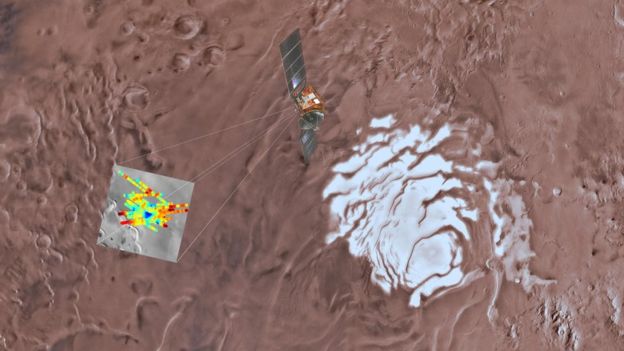
Marsis wasn't able to determine how thick the layer of water might be, but the research team estimate that it is a minimum of one metre.

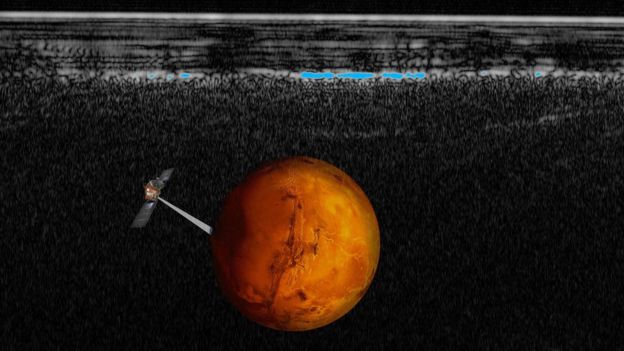
"This really qualifies this as a body of water. A lake, not some kind of meltwater filling some space between rock and ice, as happens in certain glaciers on Earth," Prof Orosei added.Image copyrightESA/INAFImage captionArtists' impression: Mars Express probing the planet's surface. Marsis radar results above.
How was it found?

Radar instruments like Marsis examine the surface and immediate subsurface of the planet by sending out a signal and examining what is bounced back.

The continuous white line at the top of the radar results above marks the beginning of the South Polar Layered Deposit; a filo pastry-like accumulation of water ice and dust.

Beneath this, researchers spotted something unusual 1.5km under the ice.

"In light blue you can see where the reflections from the bottom are stronger than surface reflection. This is something that is to us the tell tale sign of the presence of water," says Prof Orosei.Image copyrightUSGS ASTROGEOLOGY SCIENCE CENTER, ARIZONA STATE UNImage captionArtists' impression: Marsis data shows an area of high reflectivity (dark blue) which is thought to be water
What does this mean for life?

Nothing definitive. Yet.

Dr Manish Patel from the Open University explained: "We have long since known that the surface of Mars is inhospitable to life as we know it, so the search for life on Mars is now in the subsurface.

"This is where we get sufficient protection from harmful radiation, and the pressure and temperature rise to more favourable levels. Most importantly, this allows liquid water, essential for life."

This principle of following the water is key to astrobiology - the study of potential life beyond Earth.

So while the findings suggest water is present, they don't confirm anything further.

"We are not closer to actually detecting life," Dr Patel told BBC News, "but what this finding does is give us the location of where to look on Mars. It is like a treasure map - except in this case, there will be lots of 'X's marking the spots."Image copyrightSCIENCE PHOTO LIBRARYImage captionAstrobiologists study extreme environments like salt lakes on Earth to understand how life might survive on Mars
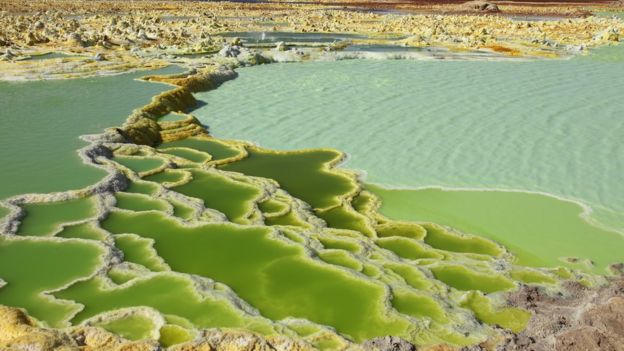
The water's temperature and chemistry could also pose a problem for any potential martian organisms.

In order to remain liquid in such cold conditions (the research team estimate between -10 and -30 Celsius where it meets the ice above), the water likely has a great many salts dissolved in it.

"It's plausible that the water may be an extremely cold, concentrated brine, which would be pretty challenging for life," explained Dr Claire Cousins, an astrobiologist from the University of St Andrews, UK.
What next?

While its existence provides a tantalising prospect for those interested in the possibility of past or present life on Mars, the lake's characteristics must first be verified by further research.

"What needs to be done now," explained Dr Matt Balme from the Open University, "is for the measurements to be repeated elsewhere to look for similar signals, and, if possible, for all other explanation to be examined and - hopefully - ruled out.

"Maybe this could even be the trigger for an ambitious new Mars mission to drill into this buried water-pocket - like has been done for sub-glacial lakes in Antarctica on Earth," he added.Image copyrightSCIENCE PHOTO LIBRARYImage captionThe area has been compared to Lake Vostok, which lies 4km beneath the Antarctic ice
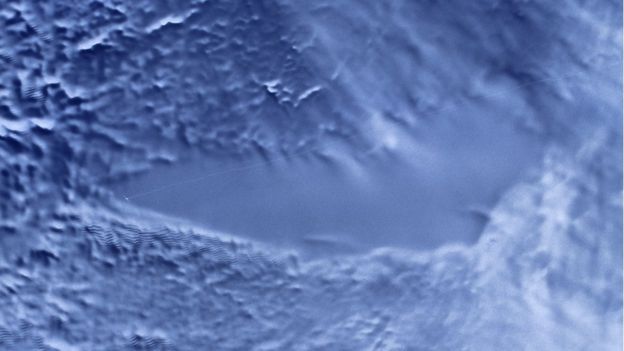
Scientists have previously claimed to find bacterial life in the buried depths of Antarctica's Lake Vostok, but drilling on Mars would make for an ambitious project indeed.

"Getting there and acquiring the final evidence that this is indeed a lake will not be an easy task," said Prof Orosei.

"It will require flying a robot there which is capable of drilling through 1.5km of ice. This will certainly require some technological developments that at the moment are not available."

The findings were reported in Science.

Tuesday, August 22, 2017

Scientists develop self-healing rubber that could mean punctured tires repair themselves as you drive


Flat tires and weak rubber bands may very soon become a thing of the past as researchers from the Harvard John A. Paulson School of Engineering and Applied Sciences (SEAS) recently developed a new tough, self-healing rubber.
While self-healing materials are not new, engineering the same properties on dry materials such as rubber poses a bigger challenge. According to the researchers, this is due to the rubber’s material make-up. Rubber is made up of polymers linked by permanent, covalent bonds that do not reconnect once broken.
The main hurdle was that both reversible and covalent bonds do not interact with one another, in the same way as water repels oil. To address this, the experts developed a molecular rope called randomly-branched polymers to link the two types of bonds on a molecular level. The research team were able to homogeneously mix two previously immiscible bonds.
Following the molecular process, the scientists were able to create a transparent, tough, self-healing rubber.
“Unlike conventional methods relying on co-solvents to promote mixing, we use molecules to physically tie these two types of bonds together, such that they are forced to mix at the molecular level. This enables a dry rubber that contains both reversible hydrogen bonds and permanent covalent crosslinks. The reversible bonds break and reform to enable self-healing ability, whereas the covalent bonds maintain the material integrity under large deformation. Consequently, the rubber is not only very tough as natural rubber, but also can self-heal upon damage,” corresponding author Li-Heng Cai told Digital Trends online.

This self-healing rubber is no typical material

According to the research team, a typical rubber material tends to snap at certain stress points once force is applied. However, the new self-healing rubber was found to develop crazes — a feature the same as cracks but otherwise connected by fibrous strands — throughout the surface when it is stretched.
The crazes were found to redistribute the stress when it comes in contact with a force. As a result, the material cannot detect a single point of stress that may cause it to crack or snap. The research team also stated that the crazes heal and the material reverts to its original form once the stress is released.
Harvard’s Office of Technology Development has already filed a patent application for the material and is currently seeking commercialization opportunities. The material’s self-healing properties may appeal to manufacturers of various rubber products.
“There is still a lot more to do. For materials science, it is not fully understood why this hybrid rubber exhibits crazes when stretched. For engineering, the applications of the hybrid rubber that take advantage of its exceptional combination of optical transparency, toughness, and self-healing ability remain to be explored. Moreover, the concept of using molecular design to mix covalent and reversible bonds to create a homogenous hybrid elastomer is quite general and should enable development of tough, self-healing polymers of practical usage,” senior author David A. Weitz said in a university press release.
Find more articles about materials science discoveries at Discoveries.news.
Sources include:

Saturday, April 29, 2017

Stunned researchers discover that the impact of walking dramatically boosts blood flow to the brain, boosting cognitive function


It’s spring time, with summer on the horizon, and many people are looking to get in shape, get back in shape, or just simply get outside and get some fresh air daily. There are several benefits to going for a brisk walk, especially in the morning, some of which you may not realize. Now, even science is proving that your feet’s impact increases blood flow to not only the heart and other muscles, but walking sends pressure waves through the arteries that increase the supply of blood to the brain.
Did you know that walking just two miles daily reduces the risk of death by nearly 50 percent? Walking in the morning reduces that risk even more. Even the risk of cancer is reduced by walking. But wait, there’s lots more walking does for you. Let’s take an inside look at this simple, enjoyable way to increase longevity and cognitive function.

Research presented at the Experimental Biology 2017 annual meeting shows walking dynamically regulates blood circulation to the brain

Researchers at New Mexico Highlands University (NMHU) discovered something amazing. Until now, scientists and health researchers thought cerebral blood flow was only involuntarily regulated by the body, and that changes in blood pressure from exercise did not effect the blood supply to the brain.
Using non-invasive ultrasound to measure carotid artery blood velocity waves and arterial diameters, the NMHU researchers measured cerebral blood flow on both sides of the brain. The effects were contrasted between the 12 healthy young adults while they were standing upright during rest and then while steadily walking about one meter per second. Though the blood circulation effects in the brain are less than those from running, they were greater than cycling, since cycling does not involve any foot impact.

From brain power to self esteem to cancer prevention, a morning walk is proving to be a huge asset for mental and physical health

Get ready to jumpstart your energy for the entire day. You don’t have to join a gym or cycle 10 miles to get in shape and get healthy. You don’t have to “cross train” or run in mini-marathons to lose weight, fight disease and get smarter. When people say, “there’s no easy way out,” they’re wrong, because walking is easy. Daily morning walks can help you regulate your sleep cycle, lower your risk of breast cancer, burn glucose, improve blood sugar levels, improve blood circulation, and increase the flow of oxygen to the brain. Want improved mental faculties? Walk. Want to raise your self-esteem? Walk. Want to reduce stress? Walk.
Taking prescription medications to alleviate “symptoms” of deeper rooted health problems can complicate matters and lead to worsening health conditions. Prescription medications are nearly always made in laboratories with chemicals, and that is why there are so many horrific side effects and “adverse events” listed on the warning labels and reviewed on the commercials on television. There’s always the freedom of choice to eat organic food, consult a naturopathic physician, investigate natural medicine, and choose an easy daily workout that won’t injure your body. Go buy some good walking shoes today and choose to walk. It’s as essential to your health as clean food and clean water.
Other benefits of walking every morning include beautiful skin, better vitamin D absorption by your body, better control of cholesterol levels, increased stamina, increased muscle strength and improved metabolism. Are you ready for some extra energy throughout the day, better mental alertness and psychological clarity?
Drop the gluten, the GMOs, the tap water and the flu shots, they’re just polluting your body. Start walking every morning and experience clarity and longevity, the natural way. Now there’s science behind the “theory” that walking helps your brain!
Learn more about the benefits of exercise at MensFitnessFocus.com and WomensFitnessFocus.com.
Sources for this article include:

Carbon dioxide “pollutant” myth totally DEBUNKED in must-see science video

Image result for pics of carbon dioxide

As part of the new Health Ranger Science effort at public education on crucial science issues of our time, I’ve just released this truly must-see video that totally debunks the false narrative of carbon dioxide as a “pollutant.”
As you’ll see explained in the video below, climate change alarmists use visual trickery and deceit to make gullible people falsely believe that CO2 is rising to unprecedented, alarming levels across our planet. In truth, CO2 is at nearly the lowest point ever recorded in the history of the planet.
In fact, using data from the NOAA and even the IPCC, it turns out that CO2 levels were as much as 15 times higher than 400 ppm in the past, and plants across the planet today are starving for CO2, the “molecule of life” for plant life across the planet (including forests, food crops and jungles).
While climate change alarmists absurdly claim CO2 is a pollutant, they neglect to tell you that without CO2, we would all die of starvation because every ecosystem on the planet would almost instantly collapse. If CO2 were dropped to zero, Earth would become a barren global desert of death entirely incapable of supporting human life at all.
Even more shockingly, most climate change cultists still have no idea that their own bodies are made of carbon, and even the THC found in all the weed they’re smoking contains 21 carbon elements per molecule (C21H30O2). Vegetarians and vegans apparently don’t realize that all the fruits, vegetables, nuts and seeds they eat are also made of carbon, as is their own blood, skin, hormones and tissues. At the same time these people are denouncing carbon as an “evil pollutant,” they are eating carbon, drinking carbon, smoking carbon and even making babies made of carbon.
Watch (and share) my full carbon dioxide science presentation below, and help educate the ignorant masses about the truth on carbon dioxide. Also read Climate Depot to learn more on this topic.

Wednesday, April 26, 2017

ACT CHECK: Bill Nye is a mechanical engineer, not “Climate Change” specialist

Image result for pic of Bill Nye
Don’t get your dinner from a gas station, don’t throw smoke bombs intended for your opponents into the wind, and don’t get your scientific information from a celebrity in a lab coat. Especially one who only has a B.S. in mechanical engineering.
(Article by Brandon Morse republished from TheBlaze.com)
These are pretty basic things people should know not to do, but the last one is something many will ignore when it comes to the case of psuedo-scientist Bill Nye.
Nye gained popularity in the 90’s when he hosted the kid’s show, Bill Nye the Science Guy. Admittedly, it was an interesting show that I tuned into often to watch when I was a kid. However, like many a Disney Channel star has done, Nye shed the shackles of a child friendly persona, and began engaging in behavior that should be too ridiculous to be consumed by the mainstream media, but is anyway.
What’s worse, is that some of this behavior is very anti-science for a guy who is oft referred to as “the science guy.”
The latest in Nye’s long line of non-scientific science came during his new Netflix series, when he had a song and dance number performed by actress Rachel Bloom. The song was called “My Sex Junk,” and it featured Bloom and some backup dancers singing and dancing about how sexuality is fluid, and transgenderism is sound science.
The clip of this performance was published to YouTube on Tuesday, and since it’s hit the web the video has gone viral, and attained a level of infamy that most of today’s more famous provocateurs would call “too much.” As of this writing, the video currently has over 100,000 views, over 11,000 “thumbs down, and only 175 “thumbs up.”
Watch the video for yourself, but be warned that it contains references to genitalia. A lot. Also, it’s really, really awkward.
I find it fascinating that Nye, the man who often complains that there are people out there ignoring “proven” science on climate, and pushes the importance of scientific discovery, is willing to completely ditch sound science and facts in the face of a political agenda.
Transgenderism, for all its promotion as today’s cause célèbre is not real in any world but the political. Science recognizes the disorder of gender dysphoria, but beyond this disorder, there is no scenario where a woman is actually a man, though she posses two X chromosomes, ovaries, and other things specific to female biology. Likewise, a man cannot menstruate or become pregnant, or give birth.
This is obvious to anyone still in grade school, but apparently not to Nye, the actor who touts himself as a man of science. For Nye, science and politics are the same thing. He said as much when he was recently on CNN, where he got into a debate with William Happer, a physicist at Princeton University. Happer – the actual scientist – got into an argument with Nye about how there isn’t any need for the global warming alarmism, and that we should be crafting and voting on policy based off of flawed computer models.
Nye fired back by first chastising CNN for having someone like Happer on, calling him a “climate denier.” He then went into spouting disproved claims about warming oceans, and mentioned that “science is political.”
The problem with Nye’s stance is that politics has agendas contained within it. Science, at least in its true sense, does not. Science is based off of fact, trial and error, and hard evidence. Politics is based off of opinion, philosophy, and and how much money you can get for voting a certain way. If Nye is truly a man of science, he should be willing to stand back, look at the evidence in front of him, and conclude that there is not more than two genders, or that throwing people in jail for being a “climate denier” is going a little too far.
In science, more debate is good, not less. A man attempting to silence others because he doesn’t agree sounds more like something a religious fanatic would do, not a man of science.
Read more at: TheBlaze.com

Sunday, April 23, 2017

Dietary myth BUSTED: Eating more salt does NOT make you drink more water… you actually use LESS water as a result

Image result for pictures of =salt

Contrary to popular belief, eating foods with a high salt content do not induce thirst, a landmark study revealed. According to researchers, high salt intake does the exact opposite by retaining more water, which in turn prompts the body to use less of it. To carry out the study, a team of international researchers from the German Aerospace Center, the Max Delbrück Center for Molecular Medicine, and the Vanderbilt University pooled data from two groups of 10 male volunteers. The groups were sealed into a mock spaceship and were subjected to two flight simulations. The simulations were designed to resemble flights to the planet Mars. The two groups were given identical diets with varying salt content over a period of several weeks. The first group was examined after 105 days, while the second group was assessed over 205 days.
“A long space voyage conserving every drop of water might be crucial. A connection between salt intake and drinking could affect your calculations – you wouldn’t want an interplanetary traveler to die because he liked an occasional pinch of salt on his food. The real interest in the simulation, however, was that it provided an environment in which every aspect of a person’s nutrition, water consumption and salt intake could be controlled and measured,” the researchers said in an article in GlobalNews.ca.
The study found that higher salt intake resulted in increased salt content in the urine. The researchers also noted an increase in urine volume in participants. However, the increase was not due in part to higher water intake. According to researchers, high salt diet caused the participants to drink less. The study also revealed that salt appeared to trigger a mechanism in the kidneys that promote water retention.
It has been previously believed that charged sodium and chloride ions bind into water molecules and flush them out through urination. However, the study showed that salts were retained in the urine, while the water moved back into the body’s system. (Related: Be on the lookout with the latest scientific findings at Discoveries.news).

Further experiment sheds light on baffling mechanism

The researchers replicated the experiment on mice and inferred that urea — a compound that forms in the liver and muscles to promote nitrogen elimination — might be involved in water retention. According to the research team, the compound accumulated in the animals’ kidneys and countered the water-drawing effects of both sodium and chloride. The kidneys served as a biological barrier that distinguishes osmolytes from water, thus preventing water loss, researchers said.
The study also revealed that this mechanism did not induce thirst, but instead raised the animals’ hunger levels. This effect was reflective of the experiment done in human participants, who reported being hungry throughout the study.
The findings provide new insight on the functions of urea in the body. “It’s not solely a waste product, as has been assumed. Instead, it turns out to be a very important osmolyte — a compound that binds to water and helps transport it. Its function is to keep water in when our bodies get rid of salt. Nature has apparently found a way to conserve water that would otherwise be carried away into the urine by salt,” said study co-author Professor Friedrich Luft in ScienceDaily.com.
The results also give new knowledge on how the human body processes water homeostasis. “We now have to see this process as a concerted activity of the liver, muscle and kidney. While we didn’t directly address blood pressure and other aspects of the cardiovascular system, it’s also clear that their functions are tightly connected to water homeostasis (maintaining a proper amount and balance of water) and energy metabolism,” study co-author Jens Titze added.
The findings were published in The Journal of Clinical Investigation.
Sources: